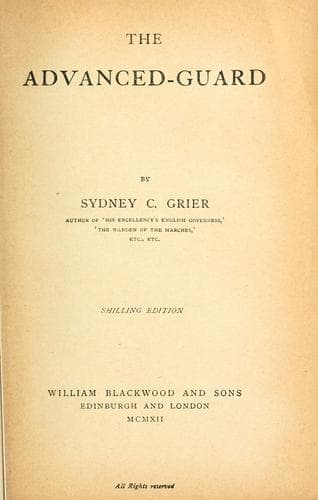
British -- Asia -- Fiction; Man-woman relationships -- Fiction; Soldiers -- Fiction
There was a community of Jews in the place, and it was from this that
his unofficial visitors were drawn--scared, furtive men, distinguished
from the true believers by their dress, who skulked along back-lanes,
and entered the house by a private door in terror of their lives, but
emboldened to the enterprise by the hope of turning a more or less
honest penny. They were anxious to be Ferrers’ agents in communicating
secretly with personages whom he could not directly approach, and, in
general, to do any dirty work that might be requisite. One of them,
more courageous than the rest, actually offered to disguise Ferrers
and take him about the city, but he felt compelled to refuse the
offer, much against his will. The man was only too probably a spy, and
what could be easier than to lead the stranger, ignorant of his
whereabouts, into the precincts of one of the mosques, and raise the
cry of “Kafir!” after which the Indian Government would have to lament
the loss of another envoy who had mysteriously disappeared. It was
very likely that the missing Whybrow had been trapped in some such
way, but Ferrers was beginning to doubt whether exact information as
to his fate would ever be obtained. The one indisputable fact was that
he had disappeared, and not he alone, but his servants, horses, arms,
and equipment, as completely as if they had never existed. The last of
his written reports which had reached Calcutta was dated half a day’s
march from the city, and in it he said that in view of his projected
entry thither he thought it well to send off beforehand the results of
his explorations up to this point. From inquiries made on the spot,
Ferrers was certain that he had left this camping-ground and gone
towards the city, but there his information stopped. No one could or
would testify to the lost man’s having passed the gates, though rumour
was rife on the subject of his doings and his fate. Ferrers’
emissaries brought him a different report every day. Whybrow had been
turned back at the gates and had returned to India; he had been
arrested on entering; he had been honourably received by the Khan and
provided with a house and escort; he had performed his business and
gone away in peace; he had been arrested during an audience at the
palace and straightway beheaded; he had been torn to pieces in the
streets; he had turned Mohammedan and been admitted to the Khan’s
bodyguard; a mutilated body alleged to be his had been subjected to
disgusting indignities at the place of execution,--all these mutually
contradictory reports were submitted, apparently in perfect good
faith, by the very same men, but they shed no certain light on the
fact of Whybrow’s disappearance.
Public-domain text, read in full here on John Shaqi.
Reviews
Reviews
No reviews yet
Be the first to share your thoughts on this work.
Elsewhere in the archive
Join the Discussion
Join the discussion
Sign in to leave a comment or review.
Sign InorCreate an account