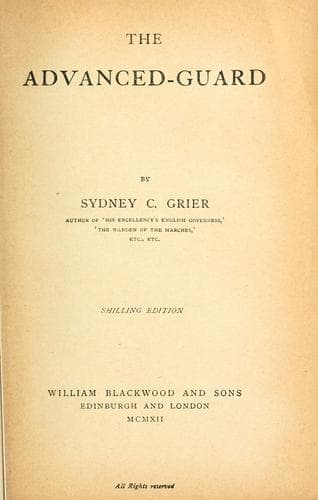
British -- Asia -- Fiction; Man-woman relationships -- Fiction; Soldiers -- Fiction
“The rats desert the sinking ship,” said Ferrers grimly; but he paid
the men their wages, and allowed them to steal out separately by the
private door, each hoping to lose himself in the labyrinth of narrow
lanes, and so elude the vengeance of the authorities until he could
find refuge with his friends. One of the men Ferrers had brought from
India also petitioned to be allowed to take his chance in this way,
and lest his presence in the house should be an element of weakness,
he was suffered to depart. The rest obeyed in silence the orders they
received. They could not understand their master’s proceedings, but
they knew well that all Sahibs were mad, and that it was expedient to
humour them even at their maddest. Moreover, this particular Sahib had
brought them through so many dangers already, apparently by virtue of
his very madness, that they felt a kind of confidence in him, and
provisions were prepared and loads made ready for an early start on
the morrow--the morrow which, for all but one in the house, was never
to come.
The street was quiet when Ferrers went his rounds before going to bed,
but he posted a sentry at the door and another at the postern, lest an
attempt should be made to break in. He had little fear of an attack
while he was behind stone walls, however; it was the ride through the
city to the gate which he really dreaded. But in the night he was
roused by the clank of metal: some one had dropped a weapon of some
sort on a stone floor. Hastily catching up his sword, he seized his
revolver and rushed out into the courtyard, to descry dimly against
the starry sky a man climbing over the wall which separated his roof
from that of the next house, and dropping down. Before he had time to
wonder whether the man was alone or had been preceded by others, he
was borne down by a sudden rush from the dark corners of the
courtyard. The revolver was struck from his hand, his sword was
wrenched away, and though he fought valiantly with his fists, he was
tripped up by a cunning wrestler and thrown to the ground, and there
bound hand and foot with marvellous celerity. Without a moment’s pause
his assailants lifted him and carried him to the door, where they tied
him upon a horse which was waiting. Hitherto he had been absolutely
dazed. Not a word had been uttered, not a sound made since that first
clang which had awakened him; and while the men were evidently armed,
they had been careful not to wound him, though he had caught sight of
more than one dead body in the courtyard and the passage. The very
stillness roused him at last to coherent thought. There was not a soul
in the street, not a ray of light nor the creak of a cautiously opened
door from the blank houses on either side. He knew the truth now. As
Whybrow had disappeared, so he was to disappear, without a sound or
cry to attract the attention of the prudent dwellers in the
neighbourhood. The bodies of his servants and all traces of their fate
Public-domain text, read in full here on John Shaqi.
Reviews
Reviews
No reviews yet
Be the first to share your thoughts on this work.
Elsewhere in the archive
Join the Discussion
Join the discussion
Sign in to leave a comment or review.
Sign InorCreate an account