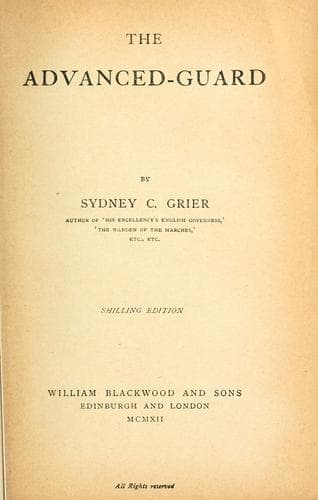
British -- Asia -- Fiction; Man-woman relationships -- Fiction; Soldiers -- Fiction
It was one night that this idea came to him, bringing with it the
unpleasant conviction that he was a great deal happier in Gamara than
he had any business to be; and in the morning he was moody and
troubled, almost making up his mind to speak plainly to the Mirza and
demand the means of escape, then deciding that it was better not to
touch on a subject which his host so pointedly avoided. They were
bidden to an entertainment that day at the house of Ghulam Nabi, one
of the Mirza’s friends, an old and trusted servant of the Khan, and
renowned even in Gamara for the strictness of his orthodoxy. The
company was a very small one, for only a few could be trusted with the
secret that besides the invariable tea and sherbets, fruit and
sweetmeats, Ghulam Nabi was wont to amuse his confidential friends
with entertainments of a more questionable character; but among them
was a nephew of the old man’s who was a student at a neighbouring
mosque, and who threatened to be a disturbing element. Ferrers had
become by this time so used to his assumed character that he no longer
took the precaution of seating himself with his back to the light
under the pretence that his eyes were weak, as he had done at first,
and he found the student’s gaze fastened on him almost continuously.
Aware that to show agitation would be the worst possible policy, he
nerved himself to maintain his usual calmness, and succeeded, as he
believed, in dispelling the youth’s suspicions. But presently, as the
guests rose to accompany their host to a pavilion in the garden, the
student flung himself forward with a shout.
“That man is a Kafir!” he cried, pointing at Ferrers. “I have been to
India, and seen the Sahibs, and he is one. He does not eat like us, he
rises from his seat differently. He is here in the holy city to spy
upon us!”
There was a stir among the guests, and they fell away from Ferrers as
if he had been denounced as plague-stricken. He himself, as if by a
sudden inspiration, attempted no defence. He looked at the Mirza, then
bowed his head, and stood in a submissive attitude. The Mirza came to
his rescue at once.
“The man is my disciple, and no Sahib,” he said. “Is this the way that
the Sahibs receive an accusation, O far-travelled one? Nay, but I have
been training this disciple of mine in patience and submission, until
I verily believe he thinks I have devised this scene to test him.
Truly he has learnt his lesson, and when I go hence, my mantle shall
be his. Is he not a worthy successor, brethren?”
“He is no true believer,” protested the student, but less confidently
than before. The rest of the company were evidently coming over to
Ferrers’ side, and Ghulam Nabi clinched the matter.
“It can easily be proved,” he said. “I am not wont to put tests to
those who come under my roof; but in order to quiet the foolish tongue
of this low-born nephew of mine, let the Mirza’s disciple repeat the
_Kalima_, that the ill-spoken boy may bow down in the dust before
him.”
Public-domain text, read in full here on John Shaqi.
Reviews
Reviews
No reviews yet
Be the first to share your thoughts on this work.
Elsewhere in the archive
Join the Discussion
Join the discussion
Sign in to leave a comment or review.
Sign InorCreate an account