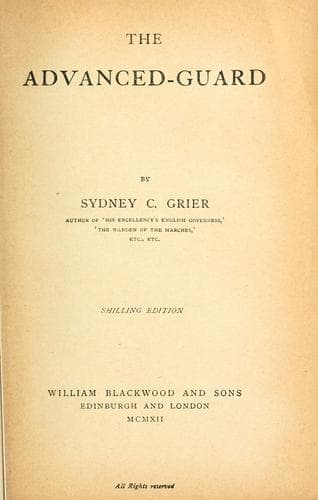
British -- Asia -- Fiction; Man-woman relationships -- Fiction; Soldiers -- Fiction
From this determination Colin could not be moved. He wrote off
immediately to Mr Crayne, asking him to obtain leave for him to resign
his commission without delay, since Major Keeling remained obdurate,
and join Saadullah Kermani’s caravan when it left Alibad for Gamara.
Mr Crayne, whose anxiety for his nephew’s safety was embittered by the
remembrance that it was he himself who had obtained him his perilous
post, made a flying journey to the river station, and summoned Colin
to meet him there, that they might talk things over. The old man was
aghast when he heard Colin’s plans. He would attempt no disguise, seek
no credentials from the Government, invoke no protection if danger
threatened. Bible and Koran in hand, he would go to the wicked city
simply as a friend in search of a friend, proving to the orthodox of
Gamara from the books they held sacred their abuse of the duties of
hospitality. Eager as he was that some definite step should be taken,
Mr Crayne recoiled from sending Colin to what seemed certain death,
and could hardly be dissuaded from dismissing the project as summarily
as Major Keeling had done. But at last Colin’s entreaties induced him
to send for Saadullah from Alibad, and after long and anxious
consultations with the trader he began to see a glimmering of hope in
the scheme. During the short time he had been on the border, Colin had
acquired a high reputation for sanctity among the natives. His austere
life, the ascetic qualities which made him unpopular among his
comrades, his willingness for religious discussion, were so many
causes for pride to the men of his troop, from whom his fame spread
first to the bazar-people of Alibad and then to the tribes. He was not
credited with the possession of miraculous powers, like Major Keeling,
but it was very commonly believed that he was divinely inspired. The
discussions which took place in his verandah might have bred
ill-feeling but for the courtesy and tact with which he conducted
them, and the bigoted Mussulmans who came to confound him and went
away defeated took with them a feeling almost of affection for their
antagonist. He might be a Kafir and a smooth-faced boy, but he could
argue against the wisest Mullahs and send them away with a lurking
doubt that what they had heard and rejected might in reality be a
message from God communicated by an angel.
Public-domain text, read in full here on John Shaqi.
Reviews
Reviews
No reviews yet
Be the first to share your thoughts on this work.
Elsewhere in the archive
Join the Discussion
Join the discussion
Sign in to leave a comment or review.
Sign InorCreate an account