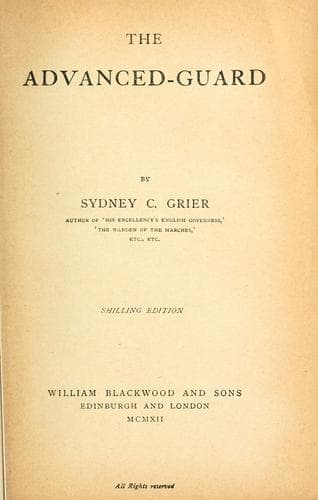
British -- Asia -- Fiction; Man-woman relationships -- Fiction; Soldiers -- Fiction
“My lord’s servant will swear it, if my lord so wills. Has he not
often beheld Firoz Sahib, both here and at Shah Nawaz? Moreover, his
history was known to all in Gamara. It seemed to my lord’s servant
that Firoz Sahib had been drinking _bang_, for his eyes were bright
and his face flushed, and Mirza Fazl-ul-Hacq, the renegade, rode at
his bridle-rein, as though to restrain him. And afterwards, when the
people were slow to disperse, he ordered the soldiers to charge the
crowd, and escaping from his friend the Mirza, rode down a Jew who
stood in his way, so that all who saw him fled. But that was not until
after----”
“After what? Go on,” said Major Keeling impatiently, as the man
hesitated.
“Let my lord pardon his servant, if that which he has to say is not
pleasing to his ears, for the dust under my lord’s feet can but tell
what he saw. There was led out into the square, before the Khan and
his court and army, another Farangi, wearing chains that would not
suffer him to walk upright, and clothed in shameful rags; and a
whisper went about among the people that it was the young sahib whom
they called the Father of a Book.”
“And was it?” demanded Major Keeling.
“How can the servant of my lord say? It so chances that his eyes never
rested upon the young sahib while he was among his own people. But
this sahib was young and tall and lean, and white like a wall--yea,
even his hair was white, yet reddish-white like that of the sahibs,
not pure white like that of the people of this land----”
“White--in those few weeks!” breathed Sir Dugald.
“Yes, yes, go on,” said Major Keeling to the narrator.
“And when the Farangi was brought out, proclamation was made by a
herald that his Highness, in his clemency, would offer the Kafir his
life on certain conditions, and that questions should be put to him in
Persian, and translated into Turki, so that the people might hear.
Then came forward Mirza Fazl-ul-Hacq, the accursed, and by command of
his Highness, asked the Farangi, ‘Wilt thou adopt the creed of Islam
and enter my army, like thy countryman yonder?’ But the Farangi,
drawing himself up in spite of his chains, made answer, ‘I am an
Englishman and a Christian, and I will neither enter thine army nor
become a Mohammedan. I choose rather to die.’ Then his Highness, in
great wrath, cried, ‘And die thou shalt!’ and the Farangi’s head was
struck off by an executioner with a great sword.”
“And did he never look at Ferrers Sahib, or speak to him?” asked Major
Keeling.
“Nay, sahib; he kept his eyes turned away from him.”
“That was not like Ross,” said Major Keeling to Sir Dugald.
“But suppose Ferrers had visited poor Ross in prison, sir--tried to
get him to abjure Christianity?” suggested Sir Dugald. “He could not
have much to say to him after that.”
“I don’t know. I should have expected Ross to think of him to the end.
And that was all?” asked Major Keeling of the messenger.
Public-domain text, read in full here on John Shaqi.
Reviews
Reviews
No reviews yet
Be the first to share your thoughts on this work.
Elsewhere in the archive
Join the Discussion
Join the discussion
Sign in to leave a comment or review.
Sign InorCreate an account