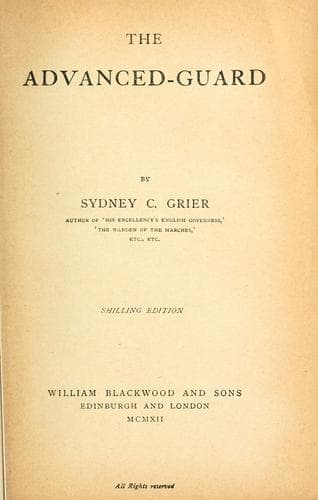
British -- Asia -- Fiction; Man-woman relationships -- Fiction; Soldiers -- Fiction
Lady Haigh and Penelope, who had not the cares of government upon
their shoulders, were much more free to enjoy themselves. They made
advances to the shy women and children of these sequestered hamlets,
who fled in terror from the white ladies, never having seen such an
alarming sight before. Sweetmeats and gaily coloured cloths were the
bribes that attracted them most readily, and after a time they would
become quite friendly, listening with uncomprehending patience while
Lady Haigh, who was a true child of her generation, tried to teach
them to adopt Western instead of Eastern ways. Those were the days in
which much stress was laid by reformers on the importance of
anglicising the native, and Lady Haigh was a good deal disheartened by
the slight result of her efforts. The women listened to her with
apparent docility, sometimes even did what she told them, under her
eye, and then went home and made their tasteless _chapatis_, or put
charms instead of eye-lotion on their babies, just as they had always
done. She gave up trying to teach them at last, and vied with Penelope
in making botanical collections, which were also a hobby of the day.
Penelope collected grasses, of which there were many varieties; and
Lady Haigh, not to be behindhand, began to collect wild-flowers, which
were much less abundant. Sir Dugald, whose tastes were not botanical,
collected skins and horns, for he managed to get a good deal of sport
in his leisure hours, and when there was nothing to shoot, he
inspected his wife’s and Penelope’s sketches, and sternly corrected
mistakes in drawing. It was a happy, healthy life, and the colour
began to return to Penelope’s cheeks and the light to her eyes. She
could think of Major Keeling now without the vision of Colin’s
anguished face rising between them, and the morbid feelings which had
preyed upon her so long had become by degrees less acute. She and Lady
Haigh called the district “the island-valley of Avilion,” rather to
the mystification of Sir Dugald, who knew his Dickens better than his
Tennyson. He was far too prudent, however, to show his bewilderment
further than by pointing out mildly that the district was neither an
island nor a valley--and besides, how could a valley be an island?
“Dugald,” said Lady Haigh one evening, when Penelope happened to be
out of earshot, “don’t you think Major Keeling would like to pay us a
visit here?”
“It’s not a bad place,” returned her husband, glancing round at the
tents pitched among the trees. “But who ever heard of a sub inviting
his chief out into camp to stay with him?”
“Oh, I didn’t mean that exactly. He might come without being
definitely asked. He would be sure to like to hear how we are getting
on, wouldn’t he? Well, if I mentioned that you have had five tigers
already, and were going after another soon----”
“You won’t mention anything of the kind,” growled Sir Dugald. “I’m
going to bag that man-eater, if any one does.”
Public-domain text, read in full here on John Shaqi.
Reviews
Reviews
No reviews yet
Be the first to share your thoughts on this work.
Elsewhere in the archive
Join the Discussion
Join the discussion
Sign in to leave a comment or review.
Sign InorCreate an account