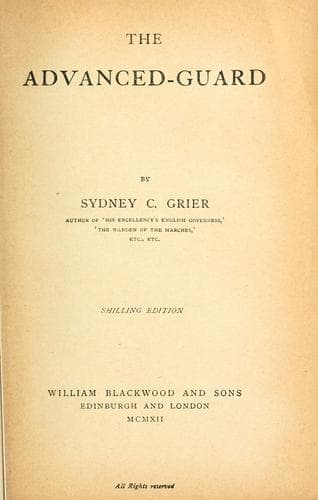
British -- Asia -- Fiction; Man-woman relationships -- Fiction; Soldiers -- Fiction
“Because the enemy’s supplies must be exhausted by then. These border
armies never carry much food with them, expecting to live on the
country. We are preventing that. There is no food to be got in the
hills, and when they burned the forest they destroyed any chances in
that direction. We have sent Harris with one of the guns to make a
flank march to the south and take up a strong position with Vidal and
his police across the road by which the enemy came, and the Sheikh
will take good care that no stragglers get past him. So far as we can
see, they must either fight or surrender.”
“But isn’t it rather cruel--starving them out in this way?”
“Cruel! If you talk of cruelty, wasn’t it cruel of them to fire the
best _shikargah_ in Khemistan? Isn’t it cruel of them now to be
keeping us grilling out on the plains, without time even for a change
of clothes? Why, until I managed to get a bath just now, I hadn’t
taken off my things since the night we rode out to find you!”
“You looked it, when you rode in two hours ago,” said Lady Haigh, with
such fervent sympathy that her husband requested her indignantly not
to be personal.
“And if we’re not to starve them out, what are we to do?” he demanded,
still smarting under the accusation of cruelty. “Of course, when an
enemy takes up his quarters in broken country inside your borders, any
fool will tell you you ought to clear him out; but what are you to do
with one weak regiment against an army? Perhaps they will let the
Chief raise another regiment after this--if we come through it--and
give him the two more European officers he’s been asking for so long.
Wilayat Ali might have swept us from the face of the earth if he had a
grain of generalship about him, and Gobind Chand’s army might have
rushed the guns a dozen times over if he could have got them to stand
fire.”
“But what is it that paralyses them?” asked Lady Haigh.
“Mutual antipathy, so far as we can make out. It seems that Wilayat
Ali carefully picked out the most disloyal Sardars to serve under
Gobind Chand, evidently in the hope that either we or they would
remove him from his path, and that the Sardars would also get their
ranks thinned. He hasn’t forgotten Gobind Chand’s attempt to get the
Chief’s help in deposing him, after all. But Gobind Chand is not eager
to take the chances of war, and the Sardars don’t quite see hurling
themselves against our guns that Wilayat Ali may have a walk-over;
and, moreover, they see through his scheme now. It’s really as good as
a play, the way the two chief villains are trying to betray one
another to us.”
“But have they actually tried to open negotiations?”
Public-domain text, read in full here on John Shaqi.
Reviews
Reviews
No reviews yet
Be the first to share your thoughts on this work.
Elsewhere in the archive
Join the Discussion
Join the discussion
Sign in to leave a comment or review.
Sign InorCreate an account