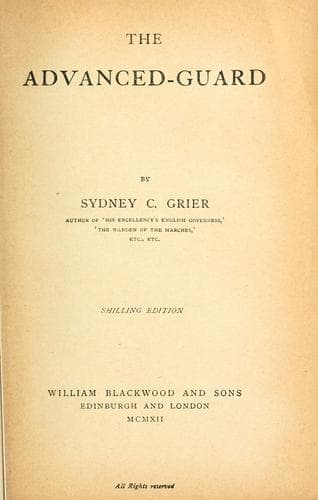
British -- Asia -- Fiction; Man-woman relationships -- Fiction; Soldiers -- Fiction
“Not that, at any rate,” said Sir Dugald. “In fact, barring accidents,
things are going on pretty well. A deputation from the Sardars came in
last night, bringing a gruesome object tied up in a bundle, which they
said was Gobind Chand’s head, sent in as a guarantee of their good
faith in offering to surrender. Their appearance would have been
sufficient proof, for it was clear they were very hard up; but the
evidence they preferred was distinctly unfortunate, for as soon as the
Chief saw it, he said, ‘It’s not Gobind Chand’s head at all. They have
killed some other Hindu of about the same age, and either they intend
treachery, or the rascal has escaped.’ We had the deputation in, and
put it to them, and in an awful fright they confessed he was right.
Gobind Chand, seeing how matters were going, had managed to get away
some hours before they found it out; but they caught one of his
hangers-on, and thought they would make use of him instead. It was a
very pretty little plan, but they hadn’t counted on the Chief’s memory
for faces.”
“Served them right!” said Lady Haigh fervently.
“Well,” Sir Dugald went on, “it was arranged that the chief Sardars
should come in this morning, as suppliants, and hear what terms the
Chief would allow them. But when they came, they were prepared with a
plan of their own. They were on the point of dethroning Wilayat Ali
before the war began, you know, and his ingenious scheme for employing
us to kill them off hasn’t increased their affection for him, so they
proposed quite frankly to proclaim Keeling Amir, and then help him to
get rid of his predecessor. They seemed to fancy the idea a good deal,
and he had quite a long argument with them about it. He would govern
them justly, as he had done Khemistan, they said, and they would be
quite willing to take service under him and fight any one he chose. He
asked them how they ventured to offer the throne to a Christian, and
they were very much amused. They had known he was a good Mussulman
ever since he came to the frontier, they said, and they were sure he
would be glad to be able to give up pretending to be a Kafir. He
assured them they were mistaken, and one after another got up and said
they had heard him read prayers in a mosque, or seen him do miracles.
Of course we knew then what they were driving at; but the trouble was,
that the more he denied it the more they were convinced it was true,
and that he was afraid of _us_. We had never known of his proceedings,
it seemed, and might make trouble for him with the Company. They
adjured him pathetically to let them see him alone, and promised that
not one of the rest of us should leave the tent alive to say what had
happened. If he would only trust himself to them, they would escort
him safely to Nalapur, and, once there, the Company might whistle for
him.”
“Dugald! you don’t mean to say they would have murdered you?”
Public-domain text, read in full here on John Shaqi.
Reviews
Reviews
No reviews yet
Be the first to share your thoughts on this work.
Elsewhere in the archive
Join the Discussion
Join the discussion
Sign in to leave a comment or review.
Sign InorCreate an account