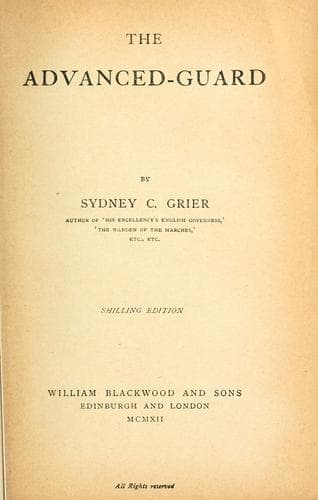
British -- Asia -- Fiction; Man-woman relationships -- Fiction; Soldiers -- Fiction
The next occasion again arrived unexpectedly soon. It was on the
morning of the second day--rumour, good and bad, having run riot in
the interval--that Sir Dugald galloped up to the verandah, and before
coming indoors, shouted for his bearer and gave him hasty orders,
sending off also a messenger to Major Keeling’s house.
“We’re off to Nalapur,” he announced hastily, walking in and taking
his seat at the breakfast-table, “to set the king on the throne of the
kingdom, otherwise to put Ashraf Ali on the _gadi_.”
“Then has Wilayat Ali surrendered, after all?” cried Lady Haigh.
“Not voluntarily, exactly, but he has been removed. Sounds bad,
doesn’t it? and I’m free to confess that the Sheikh-ul-Jabal has
managed the affair with a cleverness worthy of a worse cause. We have
been simply made use of, all along.”
“Oh, tell us what has happened! How can you think of breakfast just
now?”
“How can I? Easily, when you remember that we start in half an hour.
But I’ll do my best to combine breakfast and information. Well, when
the messengers went to invite Wilayat Ali to abdicate in favour of his
nephew, he very naturally sent back an answer breathing defiance, and
containing libellous remarks about the Sheikh’s ancestors and female
relations. The Sheikh promptly despatched a challenge to Wilayat Ali
to meet him in single combat and decide things by the result. Of
course Wilayat Ali returned a refusal, as any man in his senses would,
who had everything to lose by such a combat, and nothing to gain but
the removal of a single adversary. But here came in the Sheikh’s
sharpness. As he told us before, the Amir’s camp was full of his
adherents, and when they heard that Wilayat Ali meant to refuse the
challenge, they raised such a to-do that they nearly brought the place
about his ears. His soldiers became openly mutinous, and the
camp-followers shrieked abuse after him. He must have seen then that
he was cornered, for if he had tried to get back to his capital, he
would pretty certainly have been murdered on the road, so he accepted
the challenge as giving him his one chance. The Sheikh had laid his
plans with such deadly dexterity that there was actually nothing else
to do, for the Sardars were only too pleased to see him in a hole,
after the way he had treated them. So the lists were set--that’s how
the Chief put it--and we all stood to watch. The Sheikh left Ashraf
Ali in Keeling’s charge, and rode out. They were to fight with
javelins first, then with swords. The javelin part was rather a
farce--they threw from such a safe distance, and I don’t think one of
them hit, though one of the Sheikh’s javelins went through Wilayat
Ali’s cloak. When they had thrown all they had, they drew their swords
and really rode at each other. We couldn’t see very clearly what
happened in the first round, but it looked as if something turned the
edge of Wilayat Ali’s sword, and the Chief dashed forward and yelled,
Public-domain text, read in full here on John Shaqi.
Reviews
Reviews
No reviews yet
Be the first to share your thoughts on this work.
Elsewhere in the archive
Join the Discussion
Join the discussion
Sign in to leave a comment or review.
Sign InorCreate an account