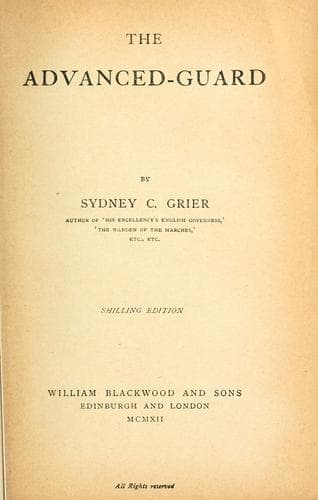
British -- Asia -- Fiction; Man-woman relationships -- Fiction; Soldiers -- Fiction
“Pretty nearly, I’m afraid; but as the Chief says, all he can do is to
go on his own way, combining fairness with perfect good faith, and
trust that Ashraf Ali may be induced to enter into a treaty when he is
freed from his uncle’s influence. The worst part of the business at
the present moment is that Gobind Chand has managed to escape into the
mountains between Nalapur and Ethiopia, and has been joined by all who
had reason to think their lives might not last long under the new
state of affairs; and of course any discontented Sardar or rebellious
Mullah will know where to find friends whenever he wants them. Keeling
tried hard to induce the Sheikh to let a force from our side of the
frontier co-operate with him in hunting the fellows down, so as to
stamp out the rebel colony before it can become the nucleus of
mischief; but he utterly refused, and professed to see the thin end of
the wedge in the proposal. They’ll never be able to do it by
themselves, and it’s bound to give us no end of trouble when we have
to take the business in hand at last. But he won’t see reason.”
“Then has Wilayat Ali’s son joined Gobind Chand?” asked Penelope.
“Ah, you are thinking of your young lady friend. No; he was caught in
time, and accepted the proposed marriage with resignation. So did the
bride--if she didn’t even suggest it herself as a means of
strengthening her brother’s position. Hasrat Ali is a Syad through his
mother, so it is a very good match, and the Sheikh seems quite
satisfied; but I rather think Ashraf Ali has some qualms. At any rate,
he is giving her the finest wedding ever seen in Nalapur, and emptying
the treasury to buy jewels for her. He has given her the title of
Moti-ul-Nissa, and has had inserted in the marriage-contract a proviso
that neither Hasrat Ali nor his household are ever to quit the city
without his leave. That is to guard against his taking her away into
some country place and ill-treating her, of course, so he has really
done all he can.”
“Oh, poor girl! poor Wazira Begum!” cried Penelope, with tears in her
eyes. “What a prospect--to marry with such a life before her!”
“They’re used to it--these native women,” said Sir Dugald, wishing to
be consolatory.
“Does that make it any better? And you--all of you--acquiesce, and
make no effort to save her!”
“My dear Miss Ross, what can we do? You know what these fellows are by
this time. If one of us so much as mentioned the young lady, it could
only be wiped out by his blood or hers, or both.”
“It feels wrong to be happy when such things are going on,” said
Penelope, pursuing a train of thought of her own, apparently. “Can
nothing be done?”
“Ask the Chief, if you care to,” said Sir Dugald. “He’s coming to
dinner to-morrow.”
Public-domain text, read in full here on John Shaqi.
Reviews
Reviews
No reviews yet
Be the first to share your thoughts on this work.
Elsewhere in the archive
Join the Discussion
Join the discussion
Sign in to leave a comment or review.
Sign InorCreate an account