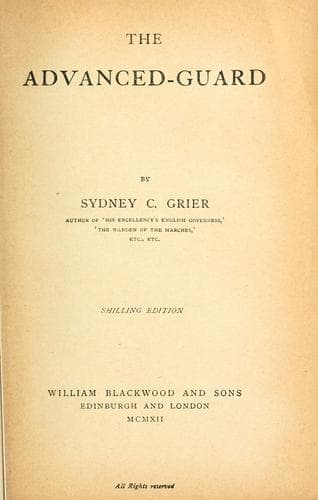
British -- Asia -- Fiction; Man-woman relationships -- Fiction; Soldiers -- Fiction
“I see. You want to shift the responsibility from your shoulders to
mine. Well, be off!” said Sir Dugald, with an uneasy laugh. He could
scarcely meet Colonel Keeling’s eye when he hurried down to him a
minute or two later, brimful of his good news, and anxious to be
assured that Lady Haigh also was going on well; and he was grateful to
Gobind Chand for choosing this juncture to launch a detachment of his
men at the steepest, and therefore least defended, side of the hill.
“Now is our time!” cried Colonel Keeling, hurrying away. “You can fire
the signal-shot, Haigh.”
The gun boomed forth, and the shot fell in the very opening of the
valley, causing the rest of Gobind Chand’s men to rush forward, in the
belief that they would be safer within the range of fire than at its
limit, an idea which seemed to be justified by the fact that Sir
Dugald left the gun as it was, instead of depressing the muzzle to
cover the enemy actually in the valley. But as the besiegers, much
encouraged, rushed forward with shouts to scale the hill, there came a
sharp rattle of musketry from the cliffs which commanded it on both
sides. The dark uniform of the Khemistan Horse showed itself against
the grey and yellow of the rocks, and Porter on one side and Harris on
the other became clearly visible as they ran along the ranks pushing
down the muzzles of the carbines, and adjuring the men to fire low for
fear of hitting the Colonel’s party. Then also the defenders of the
hill, who had been lying hidden among the rocks, started up and poured
their fire into the disorderly ranks of the besiegers, so that only
one or two daring spirits survived to reach the summit and provoke a
hand-to-hand fight with tulwars. Outwitted, and conscious that they,
and not their opponents, were in a trap, Gobind Chand’s force
remembered only that there was still a way of escape; and the wave
which had surged three times halfway up the hill retreated sullenly,
then broke in wild confusion, and rushed for the opening of the
valley. But Sir Dugald was ready for them. His gun dropped shot after
shot in the narrowest part of the passage, until a barrier of dead and
dying barred those behind from attempting the deadly rush, and when
the boldest had been able to persuade their more timid comrades, who
stood huddled in a terrified mass, to make one last united effort to
burst through, they found themselves confronted by a force composed of
every alternate man of Porter and Harris’s commands. The heights were
still occupied, the defenders of the hill had deployed and were
advancing on them from behind, in front were stern faces and levelled
carbines. There were no Ghazis with Gobind Chand, and the bulk of his
followers were not particularly heroic by nature. They knew that their
leader was wounded, and they threw down their arms and yelled for
quarter. A narrow pathway was cleared beside the ghastly heap in the
entrance of the valley, and they were made to step out man by man, and
Public-domain text, read in full here on John Shaqi.
Reviews
Reviews
No reviews yet
Be the first to share your thoughts on this work.
Elsewhere in the archive
Join the Discussion
Join the discussion
Sign in to leave a comment or review.
Sign InorCreate an account