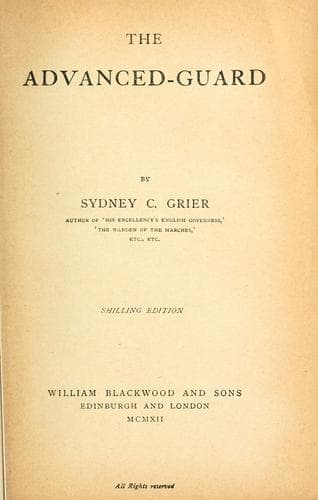
British -- Asia -- Fiction; Man-woman relationships -- Fiction; Soldiers -- Fiction
“You might let me have a word or two with the only Englishman I shall
see till Colin and I meet among the rats in the well! Any messages for
Colin? I suppose Penelope has forgotten us both long ago?”
“If you mention her name again I will kill you.” Colonel Keeling’s
grip was on his throat once more. “She is lying there dead--dead, do
you hear? and all the trouble in her life was due to you. Go!” and he
released him with a thrust which sent him reeling against one of the
pillars of the hall. But the shock seemed to have calmed him.
“Dead--just now? She married you, then? I found all the place
deserted--I didn’t know. Sometimes I think my mind is going. If you
knew what my life has been in that hell----! Forgive me, Keeling. I am
going. Wish me good luck!”
“God help you!” said Colonel Keeling fervently.
CHAPTER XXVII.
AFTER TOIL--TOIL STILL.
Nearly three years after Penelope’s death, Sir Dugald rode into
Alibad as a stranger. The long illness which followed on Lady Haigh’s
exertions on behalf of her friend so exhausted her strength that she
was ordered a voyage to the Cape as the only hope of saving her life,
and despite her frantic protests, her husband applied for two years’
leave and took her there, much as an unrelenting warder might convey a
reluctant prisoner to his doom. He was rewarded by an opportunity of
seeing service in one of the perennial Kaffir Wars of the period as
galloper to the general commanding, which served also to mitigate his
disappointment at being absent when a little war, outside the borders
of Khemistan, gave to Colonel Keeling the local rank of
Brigadier-General, and to the Khemistan Horse the chance of
distinguishing themselves beyond the bounds of their own district. Mr
Crayne had retired, and his successor proved to be that rare being, a
civilian who could make himself liked and trusted by his military
subordinates--one, moreover, who knew and appreciated the work which
had been done on the Khemistan frontier, and was anxious for its
continuance. The development of the resources of the country, at which
Major Keeling had so long laboured single-handed, was now pressed
forward in every possible way; and Sir Dugald, as he rode, noted the
handsome bazars which had replaced some, at least, of the old rows of
mud huts, and the growth of the cantonments, which testified to an
increase in the European population. The trees which he had seen
planted were now full grown, the public gardens were worthy of their
name, and there was nothing warlike in the aspect of the
weather-beaten old fort, which seemed as if the passage of years would
reduce it by slow degrees to a heap of mud grown over with bushes.
Public-domain text, read in full here on John Shaqi.
Reviews
Reviews
No reviews yet
Be the first to share your thoughts on this work.
Elsewhere in the archive
Join the Discussion
Join the discussion
Sign in to leave a comment or review.
Sign InorCreate an account