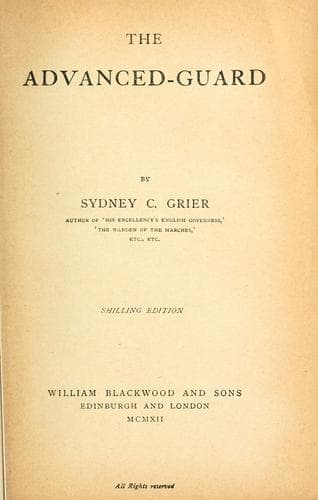
British -- Asia -- Fiction; Man-woman relationships -- Fiction; Soldiers -- Fiction
“She is absurdly like you, General,” said Sir Dugald, disapproval of
what he had just heard making itself felt in his tone, in spite of
himself, while Missy rubbed her rough head against her father’s sleeve
like a young colt.
“Horribly like me,” returned General Keeling emphatically. “Run away
and play, Missy. I can scarcely see a trace of her mother in her,” he
went on, with something of apology in his voice. “You know what my
wife was--that she couldn’t bear me out of her sight. I changed the
arrangement of this room, you remember, because she liked to be able
to see me through the open doors from where she sat, so that I could
look up and nod to her now and then. But Missy is almost like a doll,
that you can put away when you don’t want it, she’s so quiet in that
corner of hers. No; there is one thing in which she is like her
mother. If you say a hasty word to her, she will go away and break her
heart over it in her corner, instead of flaring up as I should do----”
“Or writing furious letters?” suggested Sir Dugald slily.
General Keeling smiled, but refused to be turned from his own train of
thought. “Haigh,” he said earnestly, “take care of your wife while you
have her. Mine took half my life with her when she went. If you could
imagine for one moment the difference--the awful difference--it makes,
you would go down on your knees and implore your wife’s pardon for
everything you had ever done or said that could possibly have hurt
her, and beg her not to leave you.”
“Oh, we rub along all right,” said Sir Dugald hastily, in mortal fear
that the Chief was going to be sentimental. “Elma takes everything in
good part. She understands things almost as well as a man.”
General Keeling smiled again, rather pityingly. Perhaps he had some
idea of the lofty tolerance with which Lady Haigh would have heard the
utterance of this handsome testimony. “My little Missy and I
understand one another better than that,” he said.
“Do you think of taking her home soon?” asked Sir Dugald.
“Not of taking her home. My home is here. I suppose I must send her
home some day--not yet, happily. If there was only her present
happiness and mine to consider, I would never part from her, but dress
her in boy’s clothes and take her about with me wherever I went.”
“Heaven forbid!” said Sir Dugald devoutly.
“Don’t be an old woman, Haigh,” was the crushing rejoinder. “What harm
could come to her where I was--and when the whole regiment would die
before a hair of her head should be touched? But Tarleton thinks it
would tell against the girl when she grew up, and I remember my own
youth too well to subject her to the same sort of thing. No, I shall
get your wife or some other good woman to take her home and hand her
over to her mother’s friend, Miss Marian Arbuthnot. You must have
heard Lady Haigh speak of her? They all studied together at that
College of theirs, and now Miss Arbuthnot has a school or seminary, or
whatever they call it, of her own.”
Public-domain text, read in full here on John Shaqi.
Reviews
Reviews
No reviews yet
Be the first to share your thoughts on this work.
Elsewhere in the archive
Join the Discussion
Join the discussion
Sign in to leave a comment or review.
Sign InorCreate an account