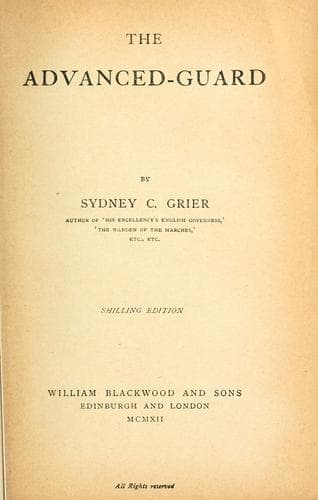
British -- Asia -- Fiction; Man-woman relationships -- Fiction; Soldiers -- Fiction
With this in his mind he left the emerald ring in Colin’s charge, and
prepared for his journey, receiving a curt notice from Major Keeling
that the leave requested by his uncle was granted, riding out to Shah
Nawaz to inform the man who was taking his place that another week’s
exile was in store for him, and bidding farewell to Penelope and Lady
Haigh. Penelope was too much relieved to see him go to take any
offence at the postponement of the engagement, and Lady Haigh hailed
his departure in private as offering an opening for the “something
that might happen,” much longed for by herself, to prevent matters
going any further. Ferrers saw through her at a glance, and rode away
laughing. He had an idea that he might be able to induce his uncle to
pay a flying visit to Alibad and make Penelope’s acquaintance, and
then he remembered suddenly that he had in his possession information
that would bring Mr Crayne to Alibad if nothing else would. He had
given up the idea of extending mercy to Major Keeling by this time. He
wanted to see him disgraced, driven from the army and from the society
of Europeans, and forced to herd with the natives whose company it was
clear that he preferred. He had not a doubt that his uncle’s feelings
would accord with his, and he devoted a good deal of time while on his
journey to going over the different points of his evidence, and
deciding on the form in which he would present it.
It was not until his second evening at Mr Crayne’s camp on the river
that he found his opportunity. The secretary and other officials who
were dragged in the Commissioner’s train, gathering that he would like
a talk with his nephew, had gladly effaced themselves on various
pretexts, and Ferrers and his uncle were left alone together. For some
time, while they smoked, Ferrers endured a bombardment of short snappy
questions, delivered in tones expressive of the deepest contempt, as
to his past career and his financial position, and heard his answers
received with undisguised sniffs. Then his chance came.
“What d’ye think of that man of yours--Keeling?” demanded Mr Crayne.
“He is--a fine soldier,” responded Ferrers guardedly.
“What d’ye hum and haw like that for, sir?” Mr Crayne added a strong
expression. “I won’t be put off by puppies like you.”
“I have no wish to put you off, sir,” said Ferrers with dignity; “but
you will understand it is difficult to give a candid opinion of one’s
commanding officer.”
“I’ll give you a candid opinion of him, if you like!” cried Mr Crayne.
“He’s the most arrogant, hot-headed, interfering, cantankerous fool
that ever wrote insubordinate letters to his superiors!”
“Oh, is that all?” The nephew’s face wore a pitying smile.
“All? What more d’ye want, sir? And what d’ye mean by grinning at me
like that, sir? I won’t stand impudence.”
“And yet you have to stand Keeling’s? He is indispensable, isn’t he?”
Public-domain text, read in full here on John Shaqi.
Reviews
Reviews
No reviews yet
Be the first to share your thoughts on this work.
Elsewhere in the archive
Join the Discussion
Join the discussion
Sign in to leave a comment or review.
Sign InorCreate an account