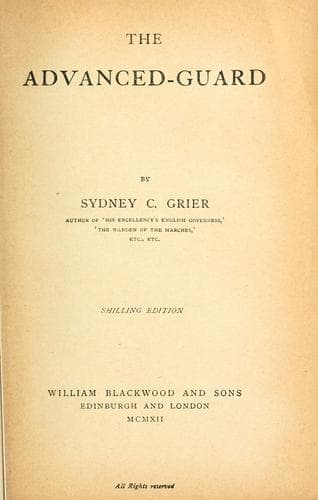
British -- Asia -- Fiction; Man-woman relationships -- Fiction; Soldiers -- Fiction
He looked at her with a questioning smile. “You know they call me a
woman-hater?” he said. “I wonder whether you agree with them? Don’t
believe it, please; it is not true. A woman-worshipper--at a
distance--would be nearer the truth. But I see you think I must be off
my head to begin in this way. Well, it was thinking of the way I was
brought up that made me do it. My mother died when I was barely three
years old: I can just remember her. When she died my father simply
withdrew from society altogether. It was said he had vowed never to
speak to a woman again: I don’t know whether that was true, but he
never did. It was easier for him than for most men to drop out of the
usual run of life, for he was not in the regular army. He had raised a
body of horse towards the end of the Mahratta Wars, and done such good
service that when they were over his commission was continued, and his
regiment recognised as irregular cavalry. But Keeling’s Horse was
never brigaded with other regiments. He had a _jaghir_ [fief] of his
own from the Emperor of Delhi, and lived there among his men and their
relations, with only one other white man, his second in command. They
both fell in love with the same woman, the daughter of a King’s
officer, and agreed to draw lots who should speak to her first, the
loser to abide loyally by the lady’s choice. My father won, and was
accepted--though how it happened I don’t know, for my mother’s friends
swore to cast her off if she married him, and did it, too. The two of
them lived perfectly happily away from other Europeans, except poor
old Franks, whose friendship with my father was not a bit interrupted,
and when my mother died, those two chummed together again as they had
done before the marriage. They both kept a sharp eye on me, and
brought me up something like the Persian boys--to ride and shoot and
to speak the truth. I shall never forget the day when I came out with
something I had picked up from the servants--of course I was a
restless little beggar, always about where I had no business to be. My
father gave me the worst thrashing I ever had in my life, and he and
Franks rubbed it into me that I had disgraced my colour and my dead
mother. I feel rather sorry for myself when I remember that night, for
I knew my father’s high standard, and I felt as if I could never look
a fellow-creature in the face again. After that the two were always
consulting together, and at last they announced to me that Franks was
going to take me home and put me to school. That was how they settled
it: my father could not leave his people and his regiment, but Franks
took the business upon himself without a murmur, and he did his duty
like a man. The funny thing was, that we were almost as solitary on
the voyage and in England as we had been in India. Franks must have
grown out of the society of his kind,--I had never known it. We took
lodgings in a little country town; there was a school there
Public-domain text, read in full here on John Shaqi.
Reviews
Reviews
No reviews yet
Be the first to share your thoughts on this work.
Elsewhere in the archive
Join the Discussion
Join the discussion
Sign in to leave a comment or review.
Sign InorCreate an account