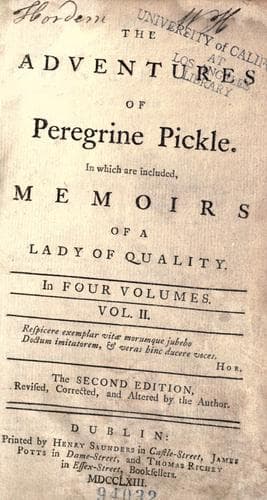
The Adventures of Peregrine PickleSmollett, T. (Tobias)
General
The Adventures of Peregrine Pickle
Smollett, T. (Tobias)
Adventure stories; Fiction; Picaresque literature
“O lad! O lad!” exclaimed the painter, with a loud laugh, “you have
fairly brought yourself into a dilemma at last, dear doctor; for it is
well known that your ancient Greek and Roman artists knew nothing at
all of the matter, in comparison with our modern masters; for this good
reason, because they had but three or four colours, and knew not how to
paint with oil: besides, which of all your old fusty Grecians would you
put upon a footing with the divine Raphael, the most excellent Michael
Angelo, Bona Roti, the graceful Guido, the bewitching Titian, and above
all others, the sublime Rubens, the--.” He would have proceeded with
a long catalogue of names which he had got by heart for the purpose,
without retaining the least idea of their several qualifications, had
not he been interrupted by his friend, whose indignation being kindled
by the irreverence with which he mentioned the Greeks, he called
him blasphemer, Goth, Boeotian, and, in his turn, asked with great
vehemence, which of those puny moderns could match with Panaenus of
Athens, and his brother Phidias; Polycletus of Sicyon; Polygnotus, the
Thracian; Parrhasius of Ephesus, surnamed Abrodiaitos, or the Beau; and
Apelles, the prince of painters? He challenged him to show any portrait
of these days that could vie with the Helen of Zeuxis, the Heraclean; or
any composition equal to the Sacrifice of Iphigenia, by Timanthes,
the Sicyonian; not to mention the Twelve Gods of Asclepiodorus, the
Athenian, for which Mnason, tyrant of Elatea, gave him about three
hundred pounds apiece; or Homer's Hell, by Nicias, who refused sixty
talents, amounting to upwards of eleven thousand pounds, and generously
made a present of it to his own country. He desired him to produce a
collection equal to that in the temple of Delphos, mentioned in the
“Ion” of Euripides; where Hercules and his companion Iolaus, are
represented in the act of killing the Lernaean hydra with golden
sickles, kruseais harpais, where Bellerophon appears on his winged
steed, vanquishing the fire-breathing chimera, tan puripneousan; and the
war of the giants is described. Here Jupiter stands wielding the red-hot
thunderbolts, keraunon amphipuron; there Pallas, dreadful to the view,
Gorgopon, brandishes her spear against the huge Euceladus; and Bacchus,
with slender ivy rods, defeats and slays the ges teknon, or the mighty
son of earth.
Public-domain text, read in full here on John Shaqi.
Reviews
Reviews
No reviews yet
Be the first to share your thoughts on this work.
Elsewhere in the archive
Join the Discussion
Join the discussion
Sign in to leave a comment or review.
Sign InorCreate an account