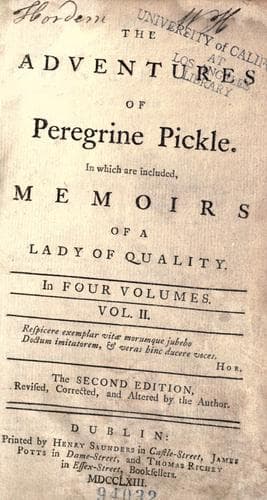
The Adventures of Peregrine PickleSmollett, T. (Tobias)
General
The Adventures of Peregrine Pickle
Smollett, T. (Tobias)
Adventure stories; Fiction; Picaresque literature
The doctor can testify
that their very horses, or more properly their live carrion, that drew
our chaise, used to reach back their long necks and smell at us, as a
couple of delicious morsels.”
This sally of Mr. Pallet, which was received with a general laugh of
approbation, would in all probability, have stifled the dispute in
embryo, had not Mr. Jolter, with a self-applauding simper, ironically
complimented the strangers on their talking like true Englishmen. The
doctor, affronted at the insinuation, told him with some warmth that he
was mistaken in his conjecture, his affections and ideas being confined
to no particular country; for he considered himself as a citizen of
the world. He owned himself more attached to England than to any other
kingdom, but this preference was the effect of reflection, and not of
prejudice; the British constitution approached nearer than any other to
that perfection of government, the democracy of Athens, he hoped one
day to see revived; he mentioned the death of Charles the First, and the
expulsion of his son, with raptures of applause; inveighed with great
acrimony against the kingly name; and, in order to strengthen his
opinion, repeated forty or fifty lines from one of the Philippics of
Demosthenes.
Jolter, hearing him speak so disrespectfully of the higher powers,
glowed with indignation: he said his doctrines were detestable, and
destructive of all right, order, and society; that monarchy was of
divine institution, therefore indefeasible by any human power; and
of consequence those events in the English history, which he had so
liberally commended, were no other than flagrant instances of sacrilege,
perfidy, and sedition; that the democracy of Athens was a most absurd
constitution, productive of anarchy and mischief, which must always
happen when the government of a nation depends upon the caprice of the
ignorant, hair-brained vulgar; that it was in the power of the most
profligate member of the commonwealth, provided he was endowed with
eloquence, to ruin the most deserving, by a desperate exertion of his
talents upon the populace, who had been often persuaded to act in the
most ungrateful and imprudent manner against the greatest patriots that
their country had produced; and, finally, he averred, that the liberal
arts and sciences had never flourished so much in a republic as under
the encouragement and protection of absolute power: witness the Augustan
age, and the reign of Louis the Fourteenth: nor was it to be supposed
that genius and merit could ever be so amply recompensed by the
individuals or distracted councils of a commonwealth, as by the
generosity and magnificence of one who had the whole treasury at his own
command.
Public-domain text, read in full here on John Shaqi.
Reviews
Reviews
No reviews yet
Be the first to share your thoughts on this work.
Elsewhere in the archive
Join the Discussion
Join the discussion
Sign in to leave a comment or review.
Sign InorCreate an account