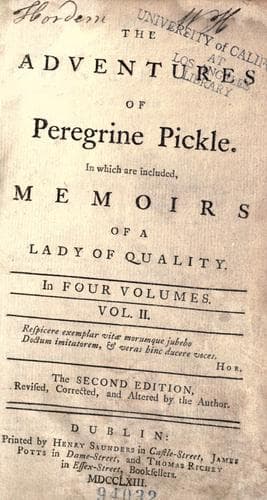
The Adventures of Peregrine PickleSmollett, T. (Tobias)
General
The Adventures of Peregrine Pickle
Smollett, T. (Tobias)
Adventure stories; Fiction; Picaresque literature
Meanwhile, the doctor having ascertained the malady of the patient,
whose cries, interrupted by frequent sobs and sighs, he interpreted into
the barking of a dog, and having no more salt-water at hand, resolved to
renew the bath with such materials as chance would afford. He actually
laid hold of the bottle and basin; but by this time the painter had
recovered the use of his senses so well as to perceive his drift,
and, starting up like a frantic bedlamite, ran directly to his sword,
swearing, with many horrid imprecations, that he would murder them both
immediately, if he should be hanged before dinner, They did not choose
to wait the issue of his threat, but retired with such precipitation
that the physician had almost dislocated his shoulder by running against
one side of the entry. Jolter, having pulled the door after him and
turned the key, betook himself to flight, roaring aloud for assistance.
His colleague, seeing the door secured, valued himself upon his
resolution, and exhorted him to return; declaring that, for his own
part, he was more afraid of the madman's teeth than of his weapon, and
admonishing the governor to re-enter and execute what they had left
undone. “Go in,” said he, “without fear or apprehension; and if any
accident shall happen to you, either from his slaver or his sword,
I will assist you with my advice, which from this station I can more
coolly and distinctly administer, than I should be able to supply if my
ideas were disturbed, or my attention engaged in any personal concern.”
Jolter, who could make no objection to the justness of the conclusion,
frankly owned that he had no inclination to try the experiment;
observing, that self-preservation was the first law of nature; that his
connections with the unhappy lunatic were but slight; and that it could
not be reasonably expected that he would run such risks for his service
as were declined by one who had set out with him from England on the
footing of a companion. This insinuation introduced a dispute upon
the nature of benevolence, and the moral sense, which, the republican
argued, existed independent of any private consideration, and could
never be affected by any contingent circumstance of time and fortune;
while the other, who abhorred his principles, asserted the duties and
excellence of private friendship with infinite rancour of altercation.
Public-domain text, read in full here on John Shaqi.
Reviews
Reviews
No reviews yet
Be the first to share your thoughts on this work.
Elsewhere in the archive
Join the Discussion
Join the discussion
Sign in to leave a comment or review.
Sign InorCreate an account