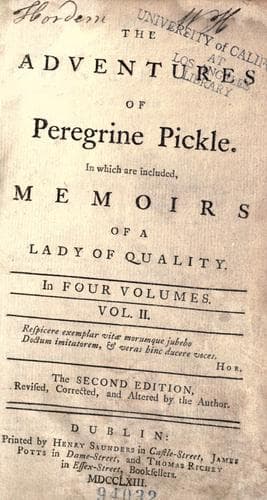
The Adventures of Peregrine PickleSmollett, T. (Tobias)
General
The Adventures of Peregrine Pickle
Smollett, T. (Tobias)
Adventure stories; Fiction; Picaresque literature
His own relations, and in particular an uncle on whom he chiefly
depended, treated him during his confinement with great rigour and
inhumanity and absolutely refused to interpose his influence in his
behalf, unless he would sign a writing, obliging himself to go to
sea within thirty days after his release, under the penalty of being
proceeded against as a felon. The alternative was, either to undergo
this voluntary exile, or remain in prison disowned and deserted by
everybody, and, after all, suffer an ignominious trial, that might end
in a sentence of transportation for life. He therefore, without much
hesitation, embraced the proposal of his kinsman, and, as he observed,
was, in less than a month after his discharge, turned adrift to the
mercy of the wind and waves.
Since that period he had never maintained any correspondence with his
relations, all of whom had concurred in sending him off; nor would he
ever pay the least regard to the humiliations and supplications of some
among them, who had prostrated themselves before him, on the advancement
of his fortune: but he retained a most inveterate resentment against
his uncle, who was still in being, though extremely old and infirm, and
frequently mentioned his name with all the bitterness of revenge.
Perry being perfectly well acquainted with the particulars of this
story, which he had heard so often repeated, proposed to Hatchway that
a person should be hired to introduce himself to the commodore, with a
supposititious letter of recommendation from this detested kinsman; an
imposition that, in all likelihood, would afford abundance of diversion.
The lieutenant relished the scheme and young Pickle having composed an
epistle for the occasion, the exciseman of the parish, a fellow of great
impudence and some humour, in whom Hatchway could confide, undertook to
transcribe and deliver it with his own hand, and also personate the
man in whose favour it was feigned to be written. He, accordingly, one
morning arrived on horseback at the garrison, two hours at least
before Trunnion used to get up, and gave Pipes, who admitted him, to
understand, that he had a letter from his master, which he was ordered
to deliver to none but the commodore himself. This message was no sooner
communicated, than the indignant chief (who had been waked for the
purpose) began to curse the messenger for breaking his rest, and swore
he would not budge till his usual time of turning out. This resolution
being conveyed to the stranger, he desired the carrier to go back and
tell him, he had such joyful tidings to impart, that he was sure the
commodore would think himself amply rewarded for his trouble, even if he
had been raised from the grave to receive them.
Public-domain text, read in full here on John Shaqi.
Reviews
Reviews
No reviews yet
Be the first to share your thoughts on this work.
Elsewhere in the archive
Join the Discussion
Join the discussion
Sign in to leave a comment or review.
Sign InorCreate an account