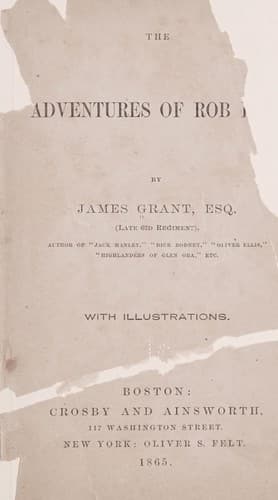
Biographical fiction; Historical fiction; Outlaws -- Fiction; Rob Roy, 1671-1734 -- Fiction; Scotland -- History -- 1689-1745 -- Fiction
The duke's rental was principally payable in kind. Thus Killearn had
established large granaries for storing up corn, meal, butter,
cheese, &c., at a place called Moulin and elsewhere, which he deemed
secure. Yet at all these storehouses Rob Roy appeared regularly,
when least expected, and demanded supplies of grain, meal, or cheese
for the use of his family, his followers, or for the poor people of
the district, who were all devoted to him, for he was deemed the
friend and father, protector and champion, of all who were
necessitous, unfortunate, or oppressed.
For the quantities thus taken he regularly gave signed receipts,
which stated that he took these goods as a return in some part for
the property of which the duke had so unjustly deprived him; and at
times he frequently compelled the Montrose tenantry to convey the
goods thus appropriated to his house at Portnellan, or wherever they
were required.
In his desperation, Montrose resolved to attempt the capture of Rob
in person, and applied to the Privy Council for authority to raise a
body of horse and foot militia among his own dependants, supposing
probably that they would be better suited to a warfare among the
mountains than the troops of the line.
It is said that the duke had such a dread of the greater or more
active enmity of Rob Roy that, singularly enough, "_his name_ was
intentionally omitted, and the act was expressed in general terms, as
being one to repress sorners, robbers, and broken men--to raise the
hue-and-cry after them, to recover goods stolen by them, and to seize
their persons."
In consequence of the state of society which then existed in the
Highlands, where the people dwelt in tribes or communities and in
sequestered glens, which were separated by great mountain ridges, by
pathless forests, while deep defiles or narrow passes formed the only
access to the country, sudden raids and onslaughts, if vigorously
conducted, could be easily made, with great peril, however, and with
certain subsequent vengeance.
The two bodies of horse and foot now mustered and armed by Montrose
were composed of men entirely devoted to him, and more or less
antagonistic to the MacGregors, at whose hands they had all suffered
severely. They wore the duke's livery--blue coats faced with red,
with trews of the Grahame tartan, and each wore in his bonnet a
laurel leaf. There was not a man among them but had something to
revenge, in the shape of a farm burned, a kinsman slain, or a herd
carried off; so the measures now put in force against him compelled
Rob Roy to be more than ever wary, for although hitherto most
fortunate in all his achievements and escapes, he could not hope to
be always so.
Selecting a time when many of the MacGregors were absent at distant
fairs, on a dusky evening in the November of 1717, it was resolved to
beat up Rob's quarters.
Public-domain text, read in full here on John Shaqi.
Reviews
Reviews
No reviews yet
Be the first to share your thoughts on this work.
Elsewhere in the archive
Join the Discussion
Join the discussion
Sign in to leave a comment or review.
Sign InorCreate an account