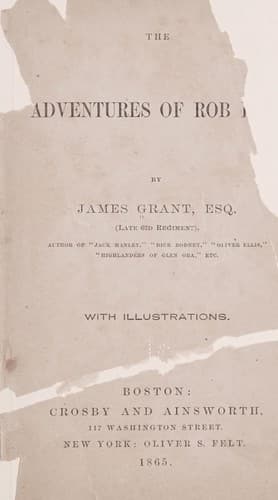
Biographical fiction; Historical fiction; Outlaws -- Fiction; Rob Roy, 1671-1734 -- Fiction; Scotland -- History -- 1689-1745 -- Fiction
And then there were Duncan and Hamish, with little Ronald, who was
always in scrapes and turmoils, and exhibited more scars and bruises
than even Greumoch, or the most veteran of the clan, what might their
fate--their future be?
Their ruddy sunburnt faces, their hearty boyish voices, all came
vividly to memory with the terrible question,--How were their lives
to end?
By a tender succession of links in his boys, he had beheld a future
life _beyond_ his own; for by the natural course of events they were
to see what he could never hope to see, or feel, or share in--the
coming time, which they were to enjoy (or endure) when his strong
hand was lying in the grave, when his sword had returned to the
anvil, and when on earth he could avail them no more. But what an
heritage of danger had he to bequeath them!
Then the future plans of the Jacobites (with whose success he
identified the restoration of his people to their own name, and of
his patrimony to himself) came before him, for he was deeply involved
in their intrigues; and about the very time of this most unexpected
capture he was to have met a messenger from the Marquis of Seaforth,
as that noble was styled by the loyalists in Scotland--a messenger
who was to precede an invasion of the Highlands from Spain.
Twilight stole over the scenery. The eagle had gone to its eyry in
the rocks; the lazy cormorant and the long-legged heron had forsaken
the shore, and all was silent, or nearly so, for no sound broke the
stillness now, save the tramp of the horses, or at times a loud
shriek that rung upon the wind, and wailed away in the distance.
It was the melancholy cry of the night-owl.
Darkness had set in when the leading files of the duke's column began
with great deliberation and care to cross the Forth at Frew. Recent
rains had swollen the river, which made a brawling sound at the
fords, though it usually rolls silently and even somewhat sluggishly
through its lovely valley, a winding course of ninety miles towards
the sea.
While the centre and rear of the horsemen were halted by the margin
of the river, the others crossed, half-fording and half-swimming, and
thereafter scrambling up the rugged bank on the opposite side, Rob
Roy began to converse in low tones with the quartermaster, James
Stewart.
The grandson of the latter was some years ago an innkeeper at Loch
Katrine, and a guide to tourists; and it was to his relation of this
adventure that Sir Walter Scott was indebted for one of the most
stirring passages in his novel, wherein, however, he designates the
trooper to whom Rob was bound "Evan of the Brigglands."
Taking advantage of the darkness, the splashing, the shouting, and
noise as the troopers crossed cautiously by two at a time, Rob
implored Stewart, "by all the ties of old acquaintance, of common
humanity, and good neighbourhood, to give him some chance of escape
from an assured doom--a death of ignominy."
Public-domain text, read in full here on John Shaqi.
Reviews
Reviews
No reviews yet
Be the first to share your thoughts on this work.
Elsewhere in the archive
Join the Discussion
Join the discussion
Sign in to leave a comment or review.
Sign InorCreate an account