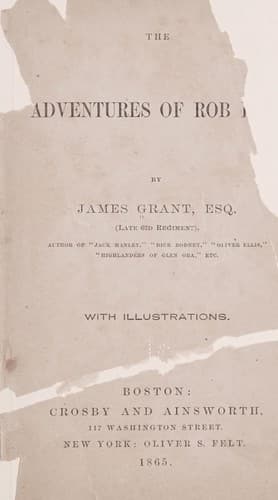
Biographical fiction; Historical fiction; Outlaws -- Fiction; Rob Roy, 1671-1734 -- Fiction; Scotland -- History -- 1689-1745 -- Fiction
"Pass on," said MacGregor, nobly, as he saluted with his sword the
defenceless officer, who almost immediately after was killed by a
stray bullet.
Driven up the hill in confusion and rage, the MacGregors now joined
the MacKenzies and MacRaes in defence of the pass; but previous to
this, a young clansman named Eoin MacPhadrig (John, son of Patrick
MacGregor) rushed back furiously among the Dutch like a tiger, and
slew five of them before he was bayoneted and killed. With a
thousand reverberations the steep hills echoed the reports of the
firearms, the cries of the wounded, and the cheers of the combatants,
as the lines drew closer.
General Wightman now recalled his skirmishers, and ordered the
Grenadiers to advance. They did so, blowing their matches and
throwing their hand-grenades as fast as possible. By the bursting of
these, several Highlanders were wounded, and Lord Seaforth fell
severely injured by a splinter, while to add still more to the
confusion and sufferings of the wounded, the heather, which was dry
as tinder, soft, and deeply rooted, caught fire by these explosions,
and now sheets of flame rolled up the mountain sides, with clouds of
murky smoke.
Under cover of this the British and Dutch infantry made no less than
three desperate attacks upon the insurgents, but were repulsed, and,
after a three hours' engagement, these combined forces had to retire,
leaving the Highlanders in complete possession of the pass, where,
according to Wightman's despatch, lay one hundred and forty-two of
his soldiers, killed and wounded.*
* Captain Dawnes and two lieutenants of the 15th were killed;
Captains Moore and Heighington of the 14th were wounded; Culcairn's
thigh was broken.
Next day, seeing the utter futility of further resistance, Don
Alonzo, whose Spaniards were naturally cold and indifferent to the
cause, and who had suffered in the conflict, surrendered the
survivors, two hundred and seventy-four in number, to Major Huske, as
prisoners of war.
On this the MacKenzies and MacRaes dispersed to places where none
could follow them; and Wightman began his retreat for Edinburgh, a
march of more than a hundred and fifty miles.
The Marquis of Tullybardine, the Earls Marischal and Seaforth, and
Sir James Livingstone, after long concealment, and though £2,000 were
offered for each of their heads, escaped and reached the Continent in
safety; and thus ended, says Salmon, "this mighty Spanish invasion,
which had so much alarmed the three kingdoms." Traces of this
conflict are still to be seen. Gun-barrels and bullets are found in
the valley, and especially behind the manse of Glensheil, where the
Spaniards, before surrendering, blew up their magazine; and there is
yet shown the green grave of the Dutch colonel, Van Rasmusson, who
fell by the hand of Rob Roy, near the small cascade which flows into
the glen.
CHAPTER XLV.
THE KNIGHT OF MALTA.
Public-domain text, read in full here on John Shaqi.
Reviews
Reviews
No reviews yet
Be the first to share your thoughts on this work.
Elsewhere in the archive
Join the Discussion
Join the discussion
Sign in to leave a comment or review.
Sign InorCreate an account