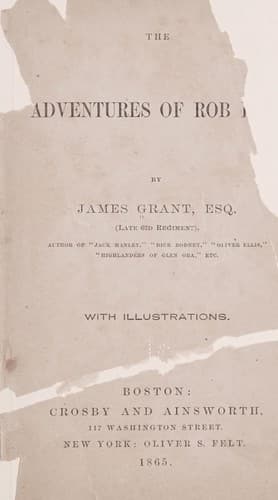
Biographical fiction; Historical fiction; Outlaws -- Fiction; Rob Roy, 1671-1734 -- Fiction; Scotland -- History -- 1689-1745 -- Fiction
On that vast purple moorland, bounded in the distance by the
countless dark-blue mountain peaks of Argyle, a picturesque group
they formed, those weather-beaten clansmen, in their garish tartans,
with their polished weapons, their round targets, and bare legs
stretched upon the heather. Then there was also the green fairy
circle, in the centre of which rose the grey old obelisk, and at its
base reclined the bearded harper on his harp. The sun as he set
beyond the western peaks crimsoned like a sheet of wine the heather
of the Blair na Carrahan, and tipped with ruddy light the harper's
silver beard and the glittering strings of his harp, as he told the
following story, which we render here, not in his poetical and
somewhat inflated Gaelic, but in our own way.
CHAPTER XLVIII.
MORRAR NA SHEAN, OR THE LORD OF THE VENISON.
Far away in the north of Caithness stands the castle of Braal, on an
eminence above the river Thurso. It is a vast square tower, with
walls of great thickness, having the narrow stairs which lead to its
various stories formed in the heart of them. A deep fosse lies on
its north side, and the remains of various other ditches and outworks
are traceable around it.
In the days of William I. of Scotland, surnamed the Lion, because he
first put that emblem on his banners and seals, this castle was one
of the many residences of Harold Earl of Caithness and Count of
Orkney, Lord of Kirkwall, Braal, and Lochmore, who was otherwise
named Morrar na Shean, or Lord of the Venison, from his passionate
love of hunting and all rural sports.
Yet his character was cruel, fierce, morose, and savage; and he loved
hunting chiefly because it was a means of indulging in bloodshed,
slaughter, and destruction.
He brained with his axe every hound which proved faulty; and on more
than one occasion, huntsmen who had erred, violated the rules of the
chase, or otherwise incurred his displeasure, were tied to trees and
left to be devoured by wolves. One, named Magnus of Staneland, he
chained to a low rock in the sea, and left there to perish miserably
by drowning as the tide rose.
Harold was a handsome and stately man, of great stature and strength.
His fair hair and beard were curly and flowing; but his eyes were
keen and wicked in expression, and his brows were ever knitted as if
in perpetual defiance or wrath, unless at times when, gorged with
food or flushed with wine, he joined in the chorus of the harpers who
sang his praises at his banquets and festivals.
He could bend a stronger bow than three men could bend together. He
was wont to twirl three sharp swords at once, catching each by its
hilt in turn; and he could walk lightly and agilely along the oars of
his great birlinn, or galley, when it was being propelled by the
rowers, most of whom were Finns or Wends, whom he had captured in the
Baltic and chained to its benches as slaves.
Public-domain text, read in full here on John Shaqi.
Reviews
Reviews
No reviews yet
Be the first to share your thoughts on this work.
Elsewhere in the archive
Join the Discussion
Join the discussion
Sign in to leave a comment or review.
Sign InorCreate an account