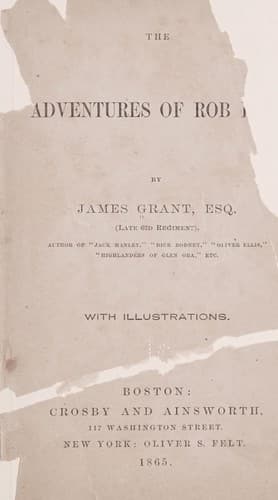
Biographical fiction; Historical fiction; Outlaws -- Fiction; Rob Roy, 1671-1734 -- Fiction; Scotland -- History -- 1689-1745 -- Fiction
"I am not prepared to die!" she exclaimed in a piercing voice; "my
sins of omission are many; oh, have mercy on me!"
"Thou art better prepared than I," said Morrar na Shean.
"At least let me say one prayer in yonder chapel ere you slay me--in
pity for my sins and soul, permit me this."
"Go, then," said Morrar, grimly; "but return quickly, lest I drag you
from its altar."
With tottering steps Gunhilda hurried into the little chapel; but ere
three minutes had elapsed, the inexorable Morrar cried,
sternly,--"Come forth!" There was no response.
"Come forth, Gunhilda, or by the Demon of the Wends I will drag thee
out!"
"I come--I come," replied a voice within the vaulted oratory, from
the arched windows of which a sudden light gleamed forth.
"'Tis well," said Morrar, "for my patience is nearly exhausted;" and
the countess, with her head bent, and muffled in her veil, approached
him from the arched doorway, through which a broad and rosy flake of
light was streaming.
Seizing her again by the arm, he dragged her to the edge of the
beetling rocks, where he meant to stab and toss her into the eddying
stream, which was rushing in full flood towards the sea; but,
marvellous to relate! as he tore the veil asunder, he beheld, not
Gunhilda, but a strange woman whose face was of wondrous beauty, and
whose head was encircled by a shining light. Then he knew in his
heart that the spirit of St. Monina stood before him! The dagger
fell from his hand; he closed his eyes with awe and dismay, and when
he looked again the figure had melted into thin air and disappeared.
Appalled by this incident, he rushed away to the wildest part of the
hills, and on being joined by Thorolf and John of Harpidale, he put
to sea as usual in his galley, and departed no one knew whither.
The countess was found by her attendants in a deep but soft slumber,
before the little altar of the river chapel; but immediately on her
return to Braal, she took her three daughters, Algiva, Erica, and
Thora, to Bishop Adam of Caithness, and besought him to conceal and
protect them; and leaving them with tears and prayers, she returned
to the home of her terrible husband, giving out that the children
were dead.
Meanwhile the bishop, with all speed, despatched them to the court of
King William the Lion, and consigned the three helpless girls to the
care of the Queen Ermengarde de Beaumont.
The vision he had beheld on that night by the river Thurso long
filled with terror the soul of Morrar na Shean; but after a time the
impression became fainter, and gradually he came to the conclusion
that the whole affair must have been a dream, originating most
probably in his wine-cup.
Public-domain text, read in full here on John Shaqi.
Reviews
Reviews
No reviews yet
Be the first to share your thoughts on this work.
Elsewhere in the archive
Join the Discussion
Join the discussion
Sign in to leave a comment or review.
Sign InorCreate an account