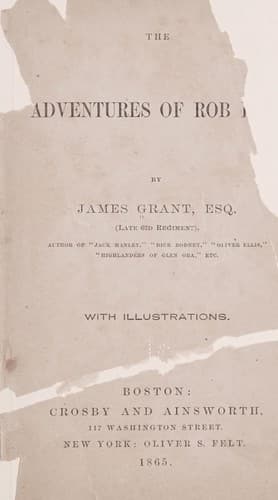
Biographical fiction; Historical fiction; Outlaws -- Fiction; Rob Roy, 1671-1734 -- Fiction; Scotland -- History -- 1689-1745 -- Fiction
Homeless, nameless, and a wanderer, with the severe parliamentary
acts of James VI. hanging over his head, the laird of Glenstrae had
to lurk in the caves and woods among the glens that had once been his
own, till he was captured by Sir James Campbell of Ardkinlass, from
whom ne made an escape, and fled to Cowal, a peninsula of Argyle,
that stretches far into the Firth of Clyde.
Here the young laird of Lamond found the poor old man, and received
and protected him in his house, with many other fugitives of the Clan
Gregor, saving them from Archibald Earl of Argyle and other powerful
enemies.
To the earl, Glenstrae at last yielded himself, on the solemn promise
that he should be sent out of Scottish ground--a promise which was
truly but fearfully kept!
He was marched as far as the English side of Berwick, under an escort
of the Scottish Horse Guard, commanded by David Murray, Lord Scone,
and then brought back to Edinburgh, where, with eighteen devoted men
of his surname, he was hanged on the 20th of January, 1604.
"Being a chief," says Birrel, "he was hanged his own height above the
rest of his friends."
It was the memory of severities such as these, together with their
local position, that fostered a spirit of resentment and ferocious
resistance to all civil law in the tribe of MacGregor.
"When I asked a very learned minister in the Highlands," says Dr.
Johnson, "which he considered the most savage clans, _those_, said
he, _which live next the Lowlands_."
This was the mere force of circumstances and position; and hence the
most warlike and predatory of the Lowland clans were those of the
borders adjoining England.
CHAPTER LI.
HE FIGHTS THE LAIRD OF BARRA.
"Rob Roy had two especial qualities," says the "New Picture of
Scotland" (published in 1807): "he spent his revenue generously, and
was a true friend to the widow and the orphan."
On his return to Portnellan, he now hoped that, by the treasure which
he had judiciously distributed among his people, they might, if the
persecution of them ceased, stock their little farms and take to
cattle-dealing, that they might all live in ease and comfort, and
that his sons might learn some of the arts of peace without
forgetting those of war.
Soon after his return from Glensheil, Rob heard that Grahame of
Killearn, who always treated the tenantry of Montrose with great
severity, had sequestrated, or distrained, the cows and furniture of
a poor woman who lived near the Highland border.
As she was a widow, and more especially as she was the widow of Eoin
Raibach, who had fallen at the storming of Inversnaid, he immediately
visited her cottage, and she burst into tears when she beheld him,
exclaiming,--
"MacGregor, _mo comraich ort_!" (my protection is thee.)
"And never was that appeal made to me in vain by the poor," replied
Rob; "I shall be your buckler and your sword of vengeance if
requisite, widow. How much do you owe Killearn?"
Public-domain text, read in full here on John Shaqi.
Reviews
Reviews
No reviews yet
Be the first to share your thoughts on this work.
Elsewhere in the archive
Join the Discussion
Join the discussion
Sign in to leave a comment or review.
Sign InorCreate an account