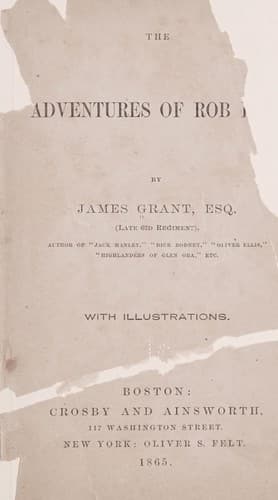
Biographical fiction; Historical fiction; Outlaws -- Fiction; Rob Roy, 1671-1734 -- Fiction; Scotland -- History -- 1689-1745 -- Fiction
These forces acted under the orders of Lieutenant-General Lord
Cadogan, colonel of the 4th Foot, who had arrived that year in
Scotland. At night they halted at Luss, the stronghold of the
Colquhouns, the hereditary foemen of Clan Alpine, where they were
joined by Sir Humphry Colquhoun, chief of his name (and fifth in
succession of him who fled from Glenfruin), with his son-in-law,
James Grant of Pluscardine, who brought some forty or fifty men of
his clan--"stately fellows," says Rae, in his history of the affair,
"in their short hose and belted plaids (_i.e._ kilts), armed each
with a well-fixed gun on his shoulder, a handsome target with a
sharp-pointed steel about half an ell in length screwed into the
navel of it, slung on his left arm, a sturdy claymore by his side,
and a pistol or two with a dirk and knife in his belt."
The man-of-war boats, which were armed with brass swivel-guns, took
all on board, and then they crossed the loch.
From the high land above Craigrostan MacGregor saw the advance of
this force, which was too strong for him to contend against alone;
and a stirring sight it must have been, on that beautiful sheet of
water--the large boats, full of men in gay scarlet uniforms, their
bright arms flashing in the sun; and it would seem, that thinking to
scare the Highlanders, they beat incessantly on their drums, while
the seamen maintained a constant discharge from their swivel-guns,
the reports of which were multiplied among the steep mountains by a
thousand echoes, as the whole expedition swept in shore towards
Craigrostan.
Rob and his men, who were concealed among the rocks, the heather, and
tall braken, high up on the mountain slope, could scarcely be
restrained from rushing to the beach and making an attack when they
saw the family banner of Sir Humphry, a saltire engrailed sable,
crested with a red hart's head, and his followers in their tartan,
which is blue striped with red; and each man wore the badge of his
name, a tuft of bear-berry in his bonnet.
The union-jack that floated in the stern of each boat seemed but a
foreign flag to MacGregor, for never had it waved on these waters
before, and the red-coated volunteers he viewed simply as invaders
and enemies; yet their strength was too great for him to hope a
victory if he opposed them.
"Oich, oich!" muttered MacAleister, and others, as James Grant's
boats, with his men in red tartans, appeared; "here come Pluscardine
and his kail-eaters"--for being the people who first cultivated that
vegetable in the north, they were named "the kail-eating Grants."
As the men began to leap ashore, with fixed bayonets, and form into
companies, young Coll MacGregor could no longer restrain his ardour
and impatience, and levelled his gun over the rocks, crying--
"A nis! a nis! a nis!" (now, now, now!) "E'en do and spaire nocht!"
Public-domain text, read in full here on John Shaqi.
Reviews
Reviews
No reviews yet
Be the first to share your thoughts on this work.
Elsewhere in the archive
Join the Discussion
Join the discussion
Sign in to leave a comment or review.
Sign InorCreate an account