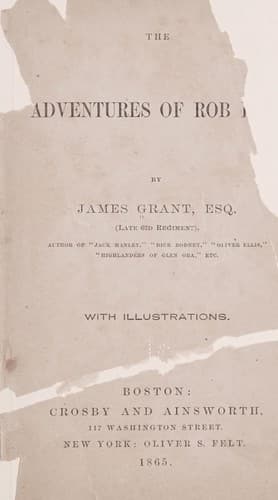
Biographical fiction; Historical fiction; Outlaws -- Fiction; Rob Roy, 1671-1734 -- Fiction; Scotland -- History -- 1689-1745 -- Fiction
"Hold, son of mine!" exclaimed his father, grasping his arm like a
vice; "boy, would you destroy us all, and, it may be, with us King
James's cause too? Let us await our time, and be assured it will
come anon."
And so, seeing that a conflict would be useless, he prudently drew
off his men to Strathfillan, where the Jacobite clans were forming a
camp, prior to their joining the Earl of Mar; while the invaders of
Craigrostan committed to the flames several thatched dwelling-houses,
and the smoke of the conflagration, as it rolled along the
mountain-slopes, added to the wrath and mortification of Rob and his
men, as they retreated up the side of Loch Lomond.
While one party of volunteers pushed on the work of destruction,
others searched for the missing boats, which they found far inland,
at Inversnaid, and drew from thence to the water. Those which were
useless they staved, or sunk, the rest were all conveyed to
Dumbarton, where they were safely moored under the guns of the
castle. And so ended the first expedition against Rob Roy, a history
of which--as if it had been a campaign in a foreign land--was
published soon after, in the form of a pamphlet.
Summonses were now issued by Government to all nobles and gentlemen,
either in arms or who were suspected of being about to arm, including
John, Earl of Mar, and fifty-two others, one of whom is designated as
"Robert Roy, _alias_ MacGregor."
CHAPTER XXI.
JOINS KING JAMES.
The brave Earl of Mar had now unfurled the standard of the exiled
king at Braemar, as lieutenant-general of his forces, and after
sending the "cross of fire" through the Highlands, in a few days he
found himself at the head of ten thousand men, and half the peers of
Scotland, with all those chiefs and gentlemen who had signed the Bond
of Union, which Rob Roy had so luckily taken from Captain Huske, in
Glendochart.
Mar's standard was of blue silk; it bore a thistle and the words NO
UNION.
The Duke of Argyle, anxious to evince his attachment to the House of
Hanover, hastened from London, to put himself at the head of his own
clan, tenants, vassals, and all the troops then in Scotland--and a
motley force they were, of English, Dutch, Switzers, and Lowland
volunteers.
That branch of the Clan Alpine which is named the race of Dugald Ciar
Mhor, was not commanded by Rob Roy at this momentous crisis, but by
his young nephew, Gregor MacGregor, of Glengyle, who was lineal head
of the house. Thus Rob served under him. Glengyle is best
remembered in Scotland by his patronymic of Glun Dhu, or
"Black-knee," from the remarkable spot, which his kilt rendered
visible, on his left knee.
He was but a youth when the insurrection of 1715 took place, so there
can be little doubt that, on most occasions, he would act under the
eye and advice of a captain so skilful and bold as his uncle.
Public-domain text, read in full here on John Shaqi.
Reviews
Reviews
No reviews yet
Be the first to share your thoughts on this work.
Elsewhere in the archive
Join the Discussion
Join the discussion
Sign in to leave a comment or review.
Sign InorCreate an account