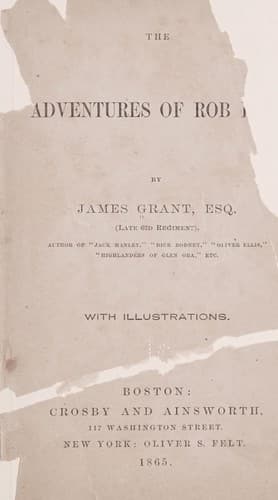
Biographical fiction; Historical fiction; Outlaws -- Fiction; Rob Roy, 1671-1734 -- Fiction; Scotland -- History -- 1689-1745 -- Fiction
Rob now lifted up the man he had saved, and to his astonishment found
him to be Captain Huske, the same officer whom he had last met in
Glendochart; so he sent him to the rear, a prisoner, in charge of his
son Coll, from whom the captain was retaken a few minutes after by a
detachment of Captain MacDougal's dragoons.
This confused battle of Sheriffmuir, or Slia Thirra, as the Celts
name it, was claimed by both parties as a victory; but Mar found
himself compelled to retire towards Perth, and to Rob Roy was
assigned the onerous task of guiding his army through the deep and
treacherous Fords of Frew, when they crossed the river Forth.
For a time after this battle Rob and his MacGregors garrisoned the
fine old royal palace of Falkland, which lies at the foot of the
Lomond hills, and the memory of that occupation still lingers in
Fifeshire; for they "harried the pharisaical Whigs" to some purpose,
laying the whole country under military contribution for miles around
the palace, from which they retired at last with considerable booty,
and after a sojourn of several weeks of jollity and ease.
Their shoes being much worn by marching, "they did not scruple to
strip the feet of any civic and clerical functionaries with whom they
chanced to meet, and whom they consoled with the jocular assurance
that his gracious majesty James VIII. would be happy to afford them
full compensation."
As the honour and advantage of the battle remained with Argyle, and
as Mar's unpaid army began to disperse from want of food and
subsistence, the insurrection soon came to an end, and the Government
acted with a merciless barbarity upon the fallen. Their severity was
worthy of the orientals alone, and in the hearts of the Highland
youth a hatred was instilled that found a terrible vent in the future
rising of 1745.
It was on the Lowland lords, however, that the hands of the Ministry
fell most heavily; for, by retreating into their mountain fastnesses,
the Highlanders defied as yet all efforts at coercion.
The following story is told of Duncan-nan-Creagh a short time after
the battle of Sheriffmuir.
A tall and powerful Highlander, who had brought a drove of cattle
into the south Lowlands, sought a night's shelter at the house of
Captain MacDougal, who, as we have stated, commanded a troop of horse
in that field.
The captain asked his Highland guest from what part of the north he
came?
"Kintail na Bogh," replied the other, with some reserve.
"Know you a place called Corrie Choing?"
"I do, captain; but why do you ask?"
Public-domain text, read in full here on John Shaqi.
Reviews
Reviews
No reviews yet
Be the first to share your thoughts on this work.
Elsewhere in the archive
Join the Discussion
Join the discussion
Sign in to leave a comment or review.
Sign InorCreate an account