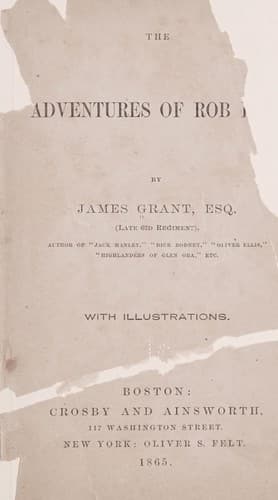
Biographical fiction; Historical fiction; Outlaws -- Fiction; Rob Roy, 1671-1734 -- Fiction; Scotland -- History -- 1689-1745 -- Fiction
It was a dark and boisterous night when the troops began their march
from the latter place, with the prisoner still bound and tied to a
horse; a horse grenadier with his unslung carbine riding on each side
of him. The clouds were driven in black masses along the summits of
Ben-ghlo and Cairn-na-Gabar (or the mountain of the goats), and the
roaring wind rolled over the thick old forests of Blair Athole,
bowing the trees till their masses seemed to heave like the waves of
the sea, in the fitful gleams of the moon. On halting at Logierait,
the duke ordered MacGregor to be kept there securely, until a
properly-mounted escort of his own people was in readiness to convey
him to Edinburgh. The duke was resolved that the whole merit of the
capture should remain with himself, and that even the king's troops
should not share it.
But this vanity proved in the end his own defeat.
Rob Roy, on finding himself in one of the miserable cottages of the
village, began to hope that he might perhaps achieve an escape. As a
preliminary, he begged the sergeant who commanded the troopers, to
undo the cords which bound his hands, that he might write a farewell
letter to his unhappy wife, who had then found shelter in the little
farmhouse of Portnellan, at the head of Loch Katrine.
The sergeant was a humane man; he said something about his own wife
and little ones who were far away in old Ireland, and he did as Rob
requested, though in defiance of express orders.
Then, as he had been liberal in supplying the soldiers with whisky
and ale, they became friendly with MacGregor, and so, after a time,
the letter was written; but there was a difficulty in procuring a
messenger to Loch Katrine, as several MacGregors had located
themselves thereabout, and reprisals were dreaded.
The stormy night wore on, and ere long all the soldiers were
sleeping, save one, who stood with his loaded carbine at the door of
the cottage.
To MacGregor it seemed as if this man pitied him, as he had been more
gentle than his comrades, and had ministered to his comfort, so far
as he dared, since the time of his betrayal at Blair.
Being strong, active, and wiry as a mountain stag, to rush on this
trooper and wrench away his carbine would have been an easy task to
MacGregor, but the key of the cottage door hung at the waist-belt of
the sleeping sergeant; thus the preliminary scuffle would only serve
to rouse the whole party, and ensure his being shot down by some of
them.
As these ideas occurred to the captive, he surveyed the sentinel,
whose gaze was never turned from him. With a swarthy, almost
olive-tinted face, and deep, dark eyes, he was a stout and handsome
young man; and his profusely-braided uniform, with its heavy red
cuffs, his Horse Grenadier cap, and tasselled boots, became him well.
He had his right hand on the lock of his carbine, the barrel of which
rested in the hollow of his left arm.
"How goes the night?" asked MacGregor.
Public-domain text, read in full here on John Shaqi.
Reviews
Reviews
No reviews yet
Be the first to share your thoughts on this work.
Elsewhere in the archive
Join the Discussion
Join the discussion
Sign in to leave a comment or review.
Sign InorCreate an account