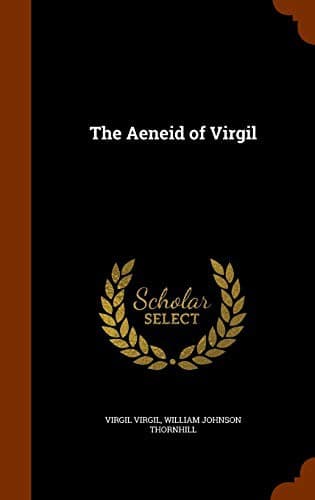
Aeneas (Legendary character) -- Poetry; Epic poetry, Latin -- Translations into English
And as when [365-398]the Edonian North wind's wrath roars on the
deep Aegean, and the wave follows it shoreward; where the blast comes
down, the clouds race over the sky; so, wheresoever Turnus cleaves his
way, columns retreat and lines turn and run; his own speed bears him on,
and his flying plume tosses as his chariot meets the breeze. Phegeus
brooked not his proud approach; he faced the chariot, and caught and
twisted away in his right hand the mouths of his horses, spurred into
speed and foaming on the bit. Dragged along and hanging by the yoke he
is left uncovered; the broad lance-head reaches him, pins and pierces
the double-woven breastplate, and lightly wounds the surface of his
body. Yet turning, he advanced on the enemy behind his shield, and
sought succour in the naked point; when the wheel running forward on its
swift axle struck him headlong and flung him to ground, and Turnus'
sword following it smote off his head between the helmet-rim and the
upper border of the breastplate, and left the body on the sand.
And while Turnus thus victoriously deals death over the plains,
Mnestheus meantime and faithful Achates, and Ascanius by their side, set
down Aeneas in the camp, dabbled with blood and leaning every other step
on his long spear. He storms, and tries hard to pull out the dart where
the reed had broken, and calls for the nearest way of remedy, to cut
open the wound with broad blade, and tear apart the weapon's
lurking-place, and so send him back to battle. And now Iapix son of
Iasus came, beloved beyond others of Phoebus, to whom once of old,
smitten with sharp desire, Apollo gladly offered his own arts and gifts,
augury and the lyre and swift arrows: he, to lengthen out the destiny of
a parent given over to die, chose rather to know the potency of herbs
and the practice of healing, and deal in a silent art unrenowned. Aeneas
stood chafing bitterly, propped on his vast spear, mourning
[399-435]Iülus and a great crowd of men around, unstirred by their
tears. The aged man, with garment drawn back and girt about him in
Paeonian fashion, makes many a hurried effort with healing hand and the
potent herbs of Phoebus, all in vain; in vain his hand solicits the
arrow-head, and his pincers' grasp pulls at the steel. Fortune leads him
forward in nowise; Apollo aids not with counsel; and more and more the
fierce clash swells over the plains, and the havoc draws nigher on.
Already they see the sky a mass of dust, the cavalry approaching, and
shafts falling thickly amid the camp; the dismal cry uprises of warriors
fighting and falling under the War-god's heavy hand. At this, stirred
deep by her son's cruel pain, Venus his mother plucked from Cretan Ida a
stalk of dittamy with downy leaves and bright-tressed flowers, the plant
not unknown to wild goats when winged arrows are fast in their body.
This Venus bore down, her shape girt in a dim halo; this she steeps with
secret healing in the river-water poured out and sparkling abrim, and
Public-domain text, read in full here on John Shaqi.
Reviews
Reviews
No reviews yet
Be the first to share your thoughts on this work.
Elsewhere in the archive
Join the Discussion
Join the discussion
Sign in to leave a comment or review.
Sign InorCreate an account