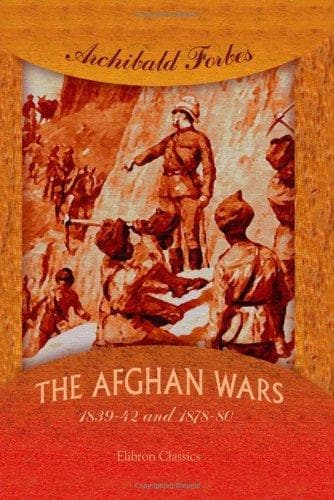
The Afghan Wars 1839-42 and 1878-80Forbes, Archibald
History
The Afghan Wars 1839-42 and 1878-80
Forbes, Archibald
Afghan Wars
By the terms of the proclamation which he issued on the 28th October Sir
Frederick Roberts was announced as the dominant authority for the time
being in Eastern and Northern Afghanistan. He occupied this position
just as far as and no further than he could make it good. And he could
make it good only over a very circumscribed area. Even more than had
been true of Shah Soojah's government forty years previously was it true
of Roberts' government now that it was a government of sentry-boxes. He
was firm master of the Sherpur cantonment. General Hills, his nominee,
held a somewhat precarious sway in Cabul in the capacity of its
Governor, maintaining his position there in virtue of the bayonets of
his military guard, the support of the adjacent Sherpur, and the waiting
attitude of the populace of the capital. East of Cabul the domination of
Britain was represented by a series of fortified posts studding the road
to Gundamuk, whence to Jumrood the occupation was closer, although not
wholly undisturbed. When a column marched out from Sherpur the British
power was dominant only within the area of its fire zone. The stretch of
road it vacated as it moved on ceased to be territory over which the
British held dominion. This narrowly restricted nature of his actual
sway Sir Frederick Roberts could not but recognise, but how with a force
of 7000 men all told was it possible for him to enlarge its borders? One
expedient suggested itself which could not indeed extend the area of his
real power, but which might have the effect, to use a now familiar
expression, of widening the sphere of his influence. From among the
Sirdars who had regarded it as their interest to cast in their lot with
the British, he selected four to represent him in the capacity of
governors of provinces which his bayonets were not long enough to reach.
The experiment made it disagreeably plain that the people of the
provinces to which he had deputed governors were utterly indisposed to
have anything to do either with them or with him. The governors went in
no state, they had no great sums to disburse, they were protected by no
armed escorts, and they were regarded by the natives much as the
Southern states of the American Union after the Civil War regarded the
'carpet bag' governors whom the North imposed upon them. The Logur
Governor was treated with utter contempt. The Kohistanees despitefully
used Shahbaz Khan, and when a brother of Yakoub Khan was sent to use his
influence in favour of the worried and threatened governor, he was
reviled as a 'Kafir' and a 'Feringhee,' and ordered peremptorily back to
Sherpur if he had any regard for his life. Sirdar Wali Mahomed, the
governor-nominate to the remote Turkestan, found pretext after pretext
for delaying to proceed to take up his functions, and had never quitted
the British camp. When Baker returned from Maidan he reported that he
had left the district peaceful in charge of the governor whom he had
Public-domain text, read in full here on John Shaqi.
Reviews
Reviews
No reviews yet
Be the first to share your thoughts on this work.
Elsewhere in the archive
Join the Discussion
Join the discussion
Sign in to leave a comment or review.
Sign InorCreate an account