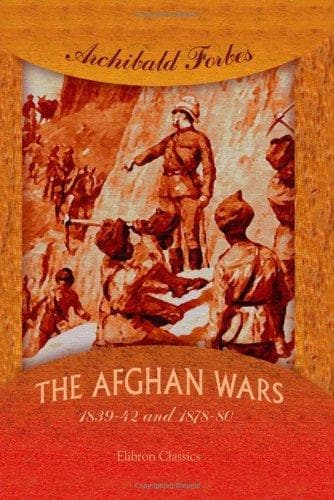
The Afghan Wars 1839-42 and 1878-80Forbes, Archibald
History
The Afghan Wars 1839-42 and 1878-80
Forbes, Archibald
Afghan Wars
On the 24th the cavalry rode far and fast in pursuit of the fugitives,
but they overtook none, such haste had the fleeing Afghans made. On the
same day Cabul and the Balla Hissar were reoccupied, and General Hills
resumed his functions as military governor of the city. Cabul had the
aspect of having undergone a sack at the hands of the enemy; the bazaars
were broken up and deserted and the Hindoo and Kuzzilbash quarters had
been relentlessly wrecked. Sir Frederick Roberts lost no time in
despatching a column to, the Kohistan to punish Meer Butcha by
destroying that chief's forts and villages, and to ascertain whether the
tribesmen of the district had dispersed to their homes. This was found
to be the case, and the column returned after having been out five days.
After making a few examples the General issued a proclamation of
amnesty, excluding therefrom only five of the principal leaders and
fomentors of the recent rising, and stipulating that the tribesmen
should send representatives to Sherpur to receive explanations regarding
the dispositions contemplated for the government of the country. This
policy of conciliation bore good fruit; and a durbar was held on January
9th, 1880, at which were present about 200 sirdars, chiefs, and headmen
from the Kohistan, Logur, and the Ghilzai country. Rewards were
presented to those chiefs who had remained friendly; the General
received the salaams of the assembled sirdars and then addressed them in
a firm but conciliatory speech.
The country remained still in a disturbed state, but there was little
likelihood of a second general rising. General Roberts was resolved,
however, to be thoroughly prepared to cope with that contingency should
it occur. Sherpur was encircled by a military road, and all cover and
obstructions for the space of 1000 yards outside the enciente were swept
away. Another road was constructed from Behmaroo village to the Siah
Sung heights and yet another from the south-eastern gateway direct to
the Balla Hissar, on both of which there were bridges across the Cabul
river. Along the northern face of Cabul from Deh Afghan to the Balla
Hissar, a road broad enough for guns was made, and another broad road
cut through the lower Balla Hissar. Another military road was built
through the Cabul gorge to the main Ghuznee and Bamian road in the
Chardeh valley. Strong forts were built on the Asmai and Sher Derwaza
heights and on the spur above the Balla Hissar, which, well garrisoned
and supplied adequately with provisions, water, and ammunition, would
enable Cabul as well as Sherpur to be held. The latter was greatly
strengthened, the eastern point of the Behmaroo heights being converted
into something like a regular fortress. Later, in March, when the Cabul
force had increased to a strength of about 11,500 men and twenty-six
guns, the command was formed into two divisions, of which the first
remained under the Lieutenant-General, the second being commanded by
Major-General John Ross.
Public-domain text, read in full here on John Shaqi.
Reviews
Reviews
No reviews yet
Be the first to share your thoughts on this work.
Elsewhere in the archive
Join the Discussion
Join the discussion
Sign in to leave a comment or review.
Sign InorCreate an account