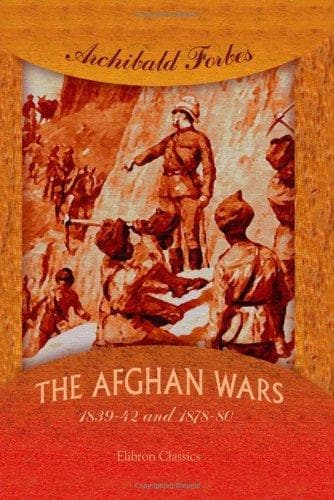
The Afghan Wars 1839-42 and 1878-80Forbes, Archibald
History
The Afghan Wars 1839-42 and 1878-80
Forbes, Archibald
Afghan Wars
Sir Donald Stewart tarried on the field only long enough to bury his
dead and have his wounded attended to; and soon after noon his force
resumed its march. Ghuznee was reached on the 21st, where there was a
halt of three days. It had been reported that the indomitable
Mushk-i-Alum was raising the tribesmen of Zurmut and Shilgur to avenge
the defeat of Ahmed Khel, and a cavalry reconnaissance made on the 22d
had found a gathering of 2000 or 3000 men about the villages of Urzoo
and Shalez, six miles south-east of Ghuznee. On the morning of the 23d a
strong column commanded by Brigadier-General Palliser moved on the
villages, which were found occupied in considerable force. They were too
solidly built to be much injured by artillery fire, and the Afghans lay
close in the shelter they afforded. Palliser hesitated to commit his
infantry to an attack. Sir Donald Stewart having arrived, ordered the
infantry to carry the villages without delay, and the affair was soon
over, the tribesmen suffering severely from the rifle fire as they
evacuated the villages, and later in the pursuit made by the cavalry and
horse-artillery. On the following day the march toward Cabul was
resumed.
On the 16th April Major-General Ross had been despatched from Cabul by
Sir Frederick Roberts on the mission of joining hands with Stewart's
division. On the 20th Ross opened heliographic communication with Sir
Donald, and was informed of the latter's victory at Ahmed Khel. But the
junction of the two forces was not accomplished until the 27th; and in
the interval the force commanded by General Ross had received
considerable annoyance at the hands of tribal levies gathered by local
chiefs. The tribesmen interfered with the roadmaking operations of his
sappers in the vicinity of Sheikabad, and some fighting occurred in very
rugged country on the 23d. Trivial loss was experienced by his command,
but the demonstrations of the tribesmen evinced with what inveterate
determination, notwithstanding so many severe lessons, the Afghans
persisted in their refusal to admit themselves conquered. Driven away
with severe loss on the 25th, those indomitable hillmen and villagers
were back again on the following morning on the overhanging ridges; nor
were they dispersed by the 'resources of civilised warfare' until more
of them had paid with their lives the penalty of their obstinate
hostility. On the 28th, at Sheikabad, Sir Donald Stewart took leave of
the division which he had led from Candahar, and proceeded to Cabul with
General Ross' force to assume the chief command in North-Eastern
Afghanistan. His division turned aside into the Logur valley, where it
remained at until the final concentration about Cabul in anticipation of
the evacuation. By the reinforcement brought by Stewart the Cabul field
force was increased to a strength of about 18,000 men.
CHAPTER VII: THE AMEER ABDURRAHMAN
Public-domain text, read in full here on John Shaqi.
Reviews
Reviews
No reviews yet
Be the first to share your thoughts on this work.
Elsewhere in the archive
Join the Discussion
Join the discussion
Sign in to leave a comment or review.
Sign InorCreate an account