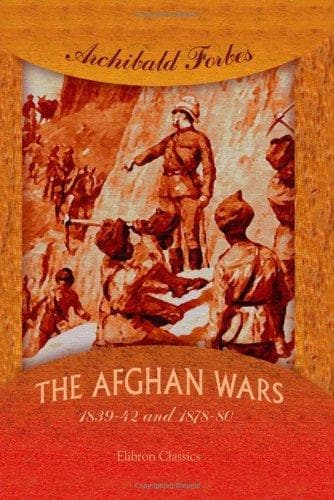
The Afghan Wars 1839-42 and 1878-80Forbes, Archibald
History
The Afghan Wars 1839-42 and 1878-80
Forbes, Archibald
Afghan Wars
patrons had furnished him with a modest equipment of arms and money, the
value of which he undertook to repay if successful. It is of course
possible that those functionaries of a notoriously simple and ingenuous
government started and equipped him in pure friendly good nature,
although they had previously consistently deterred him. But there was
not a circumstance in connection with Abdurrahman that was not
suspicious. Three distinct hypotheses seem to present themselves in
relation to this selection as our nominee; that Lord Lytton had
extraordinary, almost indeed preternatural foresight and sagacity; that
he was extremely fortunate in his leap in the dark; that he desired to
bring to the naked _reductio ad absurdum_ the 'buffer state' policy.
When Abdurrahman began his movement is uncertain. So early as the middle
of January it was reported at Sherpur that he had left Tashkend, and was
probably already on the Afghan side of the Oxus. In a letter of February
17th Mr Hensman speaks of him as being in Badakshan, where his wife's
kinsmen were in power, and describes him as having a following of 2000
or 3000 Turcoman horsemen and possessed according to native report of
twelve lakhs of rupees. On the 17th of March Lord Lytton telegraphed to
the Secretary of State that he was in possession of 'authentic
intelligence that the Sirdar was in Afghan Turkestan, having lately
arrived there from Badakshan.'
[Illustration: The Ameer Abdurrahman.]
It was regarded of urgent importance to ascertain definitely the
disposition of Abdurrahman, and whether he was disposed to throw in his
lot with the British Government, and accept the position of its nominee
in Northern Afghanistan. The agent selected by Mr Griffin to open
preliminary negotiations was a certain Mohamed Surwar, Ghilzai, who had
been all his life in the confidential service of the Sirdar's family.
Surwar was the bearer of a formal and colourless letter by way simply of
authentication; but he also carried full and explicit verbal
instructions. He was directed to inform the Sirdar that since he had
entered Afghan Turkestan and occupied places there by force of arms, it
was essential for him to declare with what object he had come, and
whether actuated by friendly or hostile feelings toward the British
Government, which for its part had no ill-feeling toward him because of
his long residence within the Russian Empire and his notoriously close
relations with that power. That the British Government was able to
benefit him very largely in comparison with that of Russia; and that
wisdom and self interest alike suggested that he should at once open a
friendly correspondence with the British officers in Cabul. That his
opportunity was now come, and that the British Government was disposed
to treat him with every consideration and to consider most favourably
any representations he might make. It had no intention of annexing the
country, and only desired to see a strong and friendly chief established
Public-domain text, read in full here on John Shaqi.
Reviews
Reviews
No reviews yet
Be the first to share your thoughts on this work.
Elsewhere in the archive
Join the Discussion
Join the discussion
Sign in to leave a comment or review.
Sign InorCreate an account