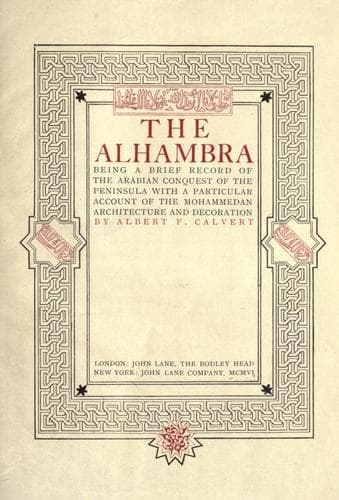
The Alhambra: being a brief record of the Arabian conquest of the Peninsula with a particular account of the Mohammedan architecture and decorationCalvert, Albert Frederick
Islamic
The Alhambra: being a brief record of the Arabian conquest of the Peninsula with a particular account of the Mohammedan architecture and decoration
“And where the sigh of the zephyr is inhaled by the noontide ray whose
scintillating beam is more refulgent than all other light.
“Between myself and the most high fortune the closest relationship
exists, and the greatest resemblance between us lies in the splendour of
our destiny.
“Every art has laid its gifts upon me; nay, all have united in
conferring perfection.
“By those who are permitted to behold me I am regarded as the Queen of
Beauty who bestoweth the prize upon her well-beloved;
“Indeed, when the enraptured observer has feasted his eyes upon me, he
will find reality surpassing the most extravagant flights of fancy;
“He will see the moon-beam start from my orbs, and its scintillation
leave me only to enter the mansions of the blest.
“The palace is a palace of transparent crystal; it appears to be
illimitable as the boundless ocean;
“And yet I am not the sole marvel of this heaven upon earth; for I
overlook with ecstacy a garden, the like of which no human eye has
contemplated.
“I was built by the Imam Ibn Nasr. May Allah uphold his majesty as a
pattern to other kings!”
The last half-dozen verses, printed _supra_, are inscribed on the jambs
of the doorway which gives entrance to the exquisite little chamber
already described. The windows of the _Mirador_ still overlook the
garden eulogised in the penultimate verse. The dado of the Hall of The
Two Sisters is a most beautiful Mosaic, presenting the same general form
on all four sides of the Hall, but differing considerably in the filling
up of the patterns.
[Illustration: THE FAVOURITE’S BALCONY.]
In the Hall of The Two Sisters formerly stood the famous Arab vase (_el
jarro_) [see pp. 77 and 95] which tradition says was discovered in one
of the subterranean chambers of the palace, “full of gold.” It is now
placed in the Museum. The vase is of the fourteenth century, and is
exquisitely enamelled in white, blue and gold. The decorations are
Hispano-Moresque, and are fully described in the work on pottery by
Peter Davillier. Another lovely amphora, is engraved in the Spanish work
_Antigüedades Arabes de España_,[10] the equal, indeed, the companion
[Illustration: EL JARRO. THE ARABIAN VASE AND NICHE IN WHICH IT FORMERLY
STOOD, HALL OF THE TWO SISTERS. THE VASE, CONSIDERABLY MUTILATED, IS NOW
IN THE MUSEUM OF THE PALACE. (_See p. 95._)]
[Illustration: HALL OF THE TWO SISTERS.]
[Illustration: VIEW IN THE HALL OF THE TWO SISTERS.]
[Illustration: DETAIL OF THE UPPER STORY, HALL OF THE TWO SISTERS.]
[Illustration: SECTION OF THE HALL OF THE TWO SISTERS, AND]
[Illustration: SECTION OF PART OF THE COURT OF THE LIONS.]
[Illustration: INSCRIPTION IN THE HALL OF THE TWO SISTERS.]
[Illustration: INSCRIPTIONS IN THE HALL OF THE TWO SISTERS.]
[Illustration: PANEL, ORNAMENT, AND INSCRIPTIONS IN THE HALL OF THE TWO
SISTERS.]
[Illustration: DETAILS ON THE FRONT OF “LINDARAJA’S” BALCONY.]
Public-domain text, read in full here on John Shaqi.
Reviews
Reviews
No reviews yet
Be the first to share your thoughts on this work.
Join the Discussion
Join the discussion
Sign in to leave a comment or review.
Sign InorCreate an account