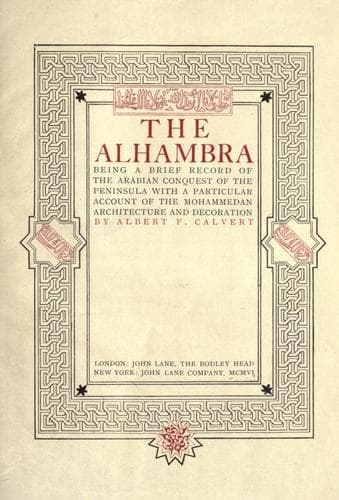
The Alhambra: being a brief record of the Arabian conquest of the Peninsula with a particular account of the Mohammedan architecture and decorationCalvert, Albert Frederick
Islamic
The Alhambra: being a brief record of the Arabian conquest of the Peninsula with a particular account of the Mohammedan architecture and decoration
About each arch is arabesque work, surrounded with a rim of characters,
consisting, for the most part, of verses from the Koràn. Unhappily, a
modern roof of red tiles disfigures this beautiful Court, which is the
most highly-prized fountain-court in the Palace.
In the centre of the Court are the twelve marble lions, conventionally
treated. Supported on the backs of the animals is the beautiful basin of
the fountain--in form, a dodecagon--out of which rises a lesser basin. A
large volume of water falling into
[Illustration: THE COURT OF THE LIONS.]
[Illustration: THE COURT OF THE LIONS.]
[Illustration: GENERAL VIEW OF THE COURT OF THE LIONS.]
[Illustration: GENERAL VIEW OF THE COURT OF THE LIONS.]
the basins, once issued from the mouths of the lions to a large
reservoir, whence it was conveyed to the apartments of the Palace.
Notwithstanding that these lions exhibit the want of development in the
art of sculpture amongst the Arabs, they yet possess a spirited, if
primitive, grace.
The inscription around the basin has been variously given: the rendering
of Pascual de Gayángos is regarded as the most
[Illustration: LITTLE TEMPLE IN THE COURT OF THE LIONS.]
[Illustration: FOUNTAIN IN THE COURT OF THE LIONS.]
authoritative. The verses, which may, perhaps, consist of twelve or so,
are couched in the usual double-shotted language of the Oriental. Two or
three are subjoined:
“Blessed be He who gave the Imam Mohammed a mansion which in beauty
excels all other mansions.
“Look at this solid mass of pearl glistening all around, which falls
within a circle of silvery froth, and then flows amidst translucent
jewels of surpassing loveliness; exceeding the marble in whiteness, and
the alabaster in transparency.
“O thou who beholdest these lions couching, fear not; _life is wanting
to enable them to show their fury_.”
The salutary warning here given irresistibly reminds one of “the
shallowest thick-skin of that barren sort” with whom the mad spirit,
Robin Goodfellow, made such frolic--the immortal
[Illustration: A LITTLE TEMPLE IN THE COURT OF THE LIONS.]
[Illustration: A PEEP INTO THE COURT OF THE LIONS.]
Athenian weaver, who opines--“To bring in--God shield us!--a lion among
ladies is a most dreadful thing; for there is not a more fearful
wild-fowl than your lion living.” Yet the admonition may not have been
altogether superfluous amongst the beauties of the hareem, who seldom
contemplated graven images. It must not be forgotten, moreover, that the
Mohammedans of Spain were somewhat lax in the matter of obedience to
certain precepts of the Koràn.
[Illustration: GENERAL VIEW OF THE COURT OF THE LIONS.]
[Illustration: PLATE XLI.
Centre Ornament of the Window.
Dado.
Dado.
Pilaster.
Pilasters.
No. 50.
Mosaic Dado in centre window on the N. side, Hall of Ambassadors.
Public-domain text, read in full here on John Shaqi.
Reviews
Reviews
No reviews yet
Be the first to share your thoughts on this work.
Elsewhere in the archive
Join the Discussion
Join the discussion
Sign in to leave a comment or review.
Sign InorCreate an account