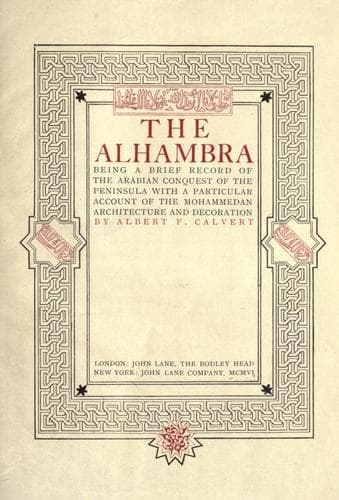
The Alhambra: being a brief record of the Arabian conquest of the Peninsula with a particular account of the Mohammedan architecture and decorationCalvert, Albert Frederick
Islamic
The Alhambra: being a brief record of the Arabian conquest of the Peninsula with a particular account of the Mohammedan architecture and decoration
The recess or divan containing these beautiful Mosaics was, doubtless,
the throne of the Moorish kings. The Mosaics are as perfect as when
originally executed, and seem, indeed, to be imperishable. They are
formed of baked clay squeezed into moulds of the different figures,
glazed on the surface.]
[Illustration: PLATE XLII.
No. 51.
Mosaic Dados on pillars between the windows, Hall of Ambassadors.
The Mosaic Dados on the pillars of the Hall of Ambassadors present a
great variety in their patterns, although the component parts are in
each the same.]
[Illustration: PLATE XLIV.
Lining of one of the columns.
Pilaster.
Dado.
Dado.
Dado.
No. 53.
Mosaics in the Hall of the Two Sisters.
The beautiful Mosaic in the centre of this plate is part of the Dado of
the Hall of the Two Sisters.]
[Illustration: PLATE XLV.
Pavement of the Hall of the Baths.
No. 54.
Mosaic Dado round the internal walls of the Mosque.
Mosaics from the Mosque and the Hall of the Baths. The Mosaic Dados
round the walls of the Mosque appear to be the only portions of the
ancient private Mosque attached to the Palace which have been preserved
intact in their original situation. The motto of the Kings of Granada,
“_There is no conqueror but God_,” was replaced by “_Nec plus ultra_” of
Charles V., when the Mosque was converted by him into a chapel. The
beautiful Mosaic at the top of the plate is placed round the fountain of
the Chamber of Repose of the Baths, described elsewhere.]
[Illustration: PLATE XLVI.
No. 55.
Azulejos. Painted Tiles.
On the floor of one of the alcoves of the Hall of Justice are to be seen
the painted tiles delineated in the centre of this plate.]
[Illustration: PLATE XLVII.
No. 56.
No. 57.
Mosaics in the Baths.]
[Illustration: PLATE XLVIII.
No. 58.
Mosaic from the portico of the Generalife.]
[Illustration: THE COURT OF THE LIONS, FROM THE WEST.]
[Illustration: TEMPLE IN THE COURT OF THE LIONS.]
[Illustration: COURT OF LIONS.]
[Illustration: SIDE ELEVATION OF THE COURT OF THE LIONS AND FOUNTAIN.]
[Illustration: ELEVATION OF THE FOUNTAIN OF THE LIONS.]
[Illustration: FOUNTAIN OF LIONS, WITH DETAILS OF THE ORNAMENT.]
[Illustration: PLAN OF THE BASIN OF THE FOUNTAIN OF LIONS.]
[Illustration: THE FIRST SIX VERSES OF THE INSCRIPTION AROUND THE BASIN
OF THE FOUNTAIN OF LIONS.]
[Illustration: PLATE XLIX.
No. 59.
Blank window, Hall of the Bark.]
[Illustration: PLATE L.
No. 60.
Soffit of arch, Entrance of the Hall of Abencerrages.]
[Illustration: PLATE LI.
No. 61.
Cornice at springing of arch of doorway at the entrance of the Ventana,
Hall of the Two Sisters.]
[Illustration: PLATE LII.
No. 62.
No. 63.
Borders of Arches.]
[Illustration: PLATE LIII.
No. 64.
Border of Arches.]
[Illustration: PLATE LIV.
No. 65.
No. 66.
Borders of Arches.]
[Illustration: PLATE LV.
No. 67.
Ornament in panels on the wall, Hall of Ambassadors.]
[Illustration: PLATE LVI.
No. 68.
Ornaments painted on the pendants, Hall of the Bark.]
Public-domain text, read in full here on John Shaqi.
Reviews
Reviews
No reviews yet
Be the first to share your thoughts on this work.
Elsewhere in the archive
Join the Discussion
Join the discussion
Sign in to leave a comment or review.
Sign InorCreate an account