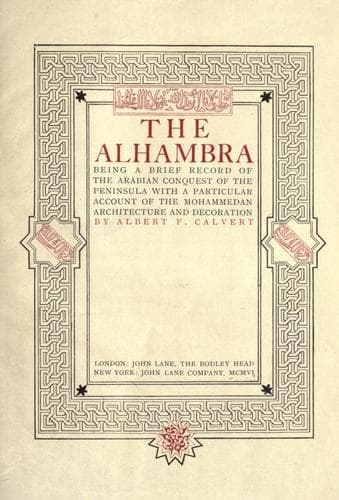
The Alhambra: being a brief record of the Arabian conquest of the Peninsula with a particular account of the Mohammedan architecture and decorationCalvert, Albert Frederick
Islamic
The Alhambra: being a brief record of the Arabian conquest of the Peninsula with a particular account of the Mohammedan architecture and decoration
[Illustration: INSCRIPTIONS IN THE HALL OF AMBASSADORS.]
[Illustration: MURAL ORNAMENT, HALL OF AMBASSADORS.]
[Illustration: ORNAMENT FROM THE SIDE OF A WINDOW, HALL OF
AMBASSADORS.]
[Illustration: ORNAMENT FROM THE SIDE OF A WINDOW, HALL OF
AMBASSADORS.]
[Illustration: PLATE LXXXI.
Cornice and window in the centre of the Façade of the Mosque.]
[Illustration: PLATE LXXXII.
Detail of the central part of “Lindaraja’s” Balcony.]
[Illustration: PLATE LXXXIII.
Lower part of “Lindaraja’s” Balcony.]
[Illustration: ORNAMENT FROM THE SIDE OF A WINDOW, NORTH FRONT OF THE
HALL OF AMBASSADORS.]
[Illustration: ORNAMENT IN THE SIDE OF A WINDOW, HALL OF AMBASSADORS.]
[Illustration: A CEILING IN OUTLINE, HALL OF AMBASSADORS.]
[Illustration: THE CEILING OF THE DOME LAID FLAT, HALL OF AMBASSADORS.]
[Illustration: DETAILS OF GLAZED TILES IN THE HALL OF AMBASSADORS.]
[Illustration: MOSAIC IN DADO, EAST SIDE OF THE HALL OF AMBASSADORS.]
[Illustration: MOSAIC IN DADO, NORTH SIDE OF THE HALL OF AMBASSADORS.]
[Illustration: MOSAIC IN DADO, HALL OF AMBASSADORS.]
[Illustration: MOSAIC IN DADO, HALL OF AMBASSADORS.]
the Moorish kings, as indicated both by the inscriptions on the walls,
and the extraordinary care bestowed upon the decoration of the recess.
The Mosaic dados present a great variety in their patterns, the
combinations being endless.
“The colours of blue, red, and gold are still to be seen on the capital
of the column of the centre window of the Hall, but no traces of gold,
or any colour, have been discovered
[Illustration: CEILING OF GALLERY, HALL OF AMBASSADORS.]
on the shaft. The same thing occurs in the Court of the Fish-pond and
the Court of the Lions, but, in each case, the harmony of the colouring
appears to require that they should be gilt. It is probable that in the
restorations which the Palace underwent during the residence of the
Spanish kings, it was found much more easy to remove the gold from the
columns, exposing the white marble, than to incur the expense of re-
gilding.” Such is the opinion of the famous decorative artist, Owen
Jones; but the fondness of the Oriental for the spotless purity of
marble, and the transparency of alabaster, so oft expressed in the
inscriptions, forbids its acceptance.
In the several alcoves, or divans, which surround the Hall, the walls
are covered with plaster ornaments in relief, presenting the greatest
variety; the patterns in each divan being different.
[Illustration: EXTERIOR OF THE MOSQUE (PRIVATE PROPERTY).]
Beneath this Golden Saloon is a network of dungeon-like passages, by
which, it is said, Sultáns escaped in treasonable revolts, when angry
scimitars were glittering in the fountain-courts, or when the incensed
populace were tossing their threatening spears in the humming city
below. Here is also a prison-cell sort of room, with whispering holes at
each end, which
[Illustration: PLATE LXXXIV.
Detail of the lateral windows in the Hall of the Two Sisters.]
Public-domain text, read in full here on John Shaqi.
Reviews
Reviews
No reviews yet
Be the first to share your thoughts on this work.
Elsewhere in the archive
Join the Discussion
Join the discussion
Sign in to leave a comment or review.
Sign InorCreate an account