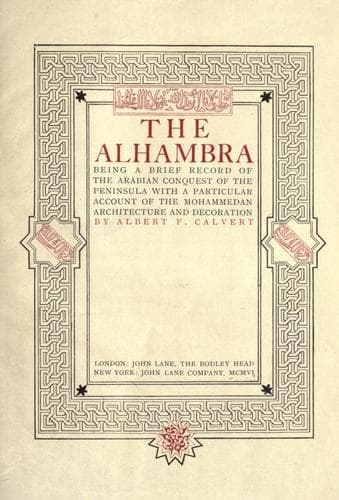
The Alhambra: being a brief record of the Arabian conquest of the Peninsula with a particular account of the Mohammedan architecture and decorationCalvert, Albert Frederick
Islamic
The Alhambra: being a brief record of the Arabian conquest of the Peninsula with a particular account of the Mohammedan architecture and decoration
The old Mosque, afterwards a chapel, was “purged” and consecrated by
Ferdinand and Isabella, and retains but few traces of its purpose during
the Moorish Dominion. The door was once overlaid with bronze, and, like
all the rest of the Palace, was stripped and spoiled by generations of
guardian thieves, who allowed no one but themselves to steal. Above the
door is still the exquisite-laced niche where the Korán used to be
placed by the green-turbaned Moollahs. Near the entrance is an elaborate
and beautiful niche, which was probably the _Mihráb_, or sanctuary of
the Mosque. Whilst at his prayers in this _Mihráb_, the martyred
Yúsuf--he who built the Gate of Justice in 1348, and who completed the
Alhambra--fell a victim to the dagger of an assassin in the year 1354.
The inscriptions in the Mosque, which were dumb to the conquerors, still
protest for the old faith, and cry aloud from barge-board and netted
rafter, “Be not one of the negligent.” “God is our refuge in every time
of trouble.”
LOS BAÑOS--THE BATHS.
The plan of these Baths is very similar to the arrangement still used
throughout the East.
[Illustration: CHAMBER OF REPOSE.]
From the elegant little saloon at the entrance where the bathers
unrobed, and whither they resorted after the bath, we pass, by a
circuitous passage, in which are two smaller baths, into the general
vapour-bath, paved with white marble, and lighted with openings in the
form of stars, lined with glazed earthenware. This corresponds with the
apartment called by the Arabs the _hararah_, or vapour-bath, and
described in Lane’s _Manners and Customs of the Modern Egyptians_; and
it was under the graceful arcades which support the dome that the
bathers
[Illustration: CHAMBER OF REPOSE.]
underwent the attentions of the _masseuses_ who waited on them. From the
great hall we pass into a smaller one, having at each end a marble tank,
used for solitary ablutions. Beyond, at the present day, an accumulated
heap of ruins prevents the recognition of the means for heating the
bath.
The upper part of the Chamber of Repose, which is supported on marble
columns, forms a gallery with small divans, in which two persons, or, at
most, four, could be accommodated at
[Illustration: CHAMBER OF REPOSE.]
the same time; from which it would appear that the bath was confined
entirely to the use of the sovereign and his hareem. The floor is paved
with beautiful Mosaics, which are in perfect preservation.
Inscription: “What is most to be wondered at is the felicity which
awaits men in this palace of delight.”
Los Baños are well preserved, for they lie out of the way of ordinary
ill-usage. The vapour-bath is lighted from above by small lumbreras, or
“louvres.”
GARDEN OF “LINDARAJA.”
The _Mirador_--Prospect-chamber--of “Lindaraja” overlooks this secluded
little court or garden, with its alabaster fountain, its cypress,
orange, and citron trees rising from trim
Public-domain text, read in full here on John Shaqi.
Reviews
Reviews
No reviews yet
Be the first to share your thoughts on this work.
Elsewhere in the archive
Join the Discussion
Join the discussion
Sign in to leave a comment or review.
Sign InorCreate an account