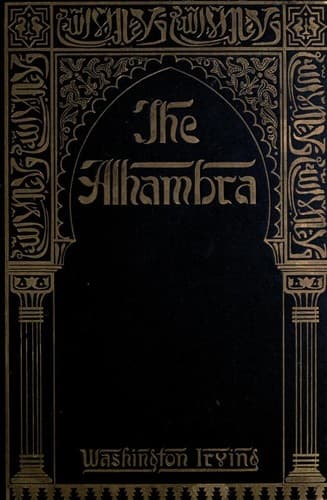
Verhalen over het gebouwencomplex in Granada, dat eigendom was van de laatste islamitische vorsten in Spanje.
Aben Habuz approached him with a conciliatory tone. “O wise son of Abu
Ayub,” said he, “well didst thou predict dangers to me from this captive
beauty: tell me then, thou who art so quick at foreseeing peril, what I
should do to avert it.”
“Put from thee the infidel damsel who is the cause.”
“Sooner would I part with my kingdom,” cried Aben Habuz.
“Thou art in danger of losing both,” replied the astrologer.
“Be not harsh and angry, O most profound of philosophers; consider the
double distress of a monarch and a lover, and devise some means of
protecting me from the evils by which I am menaced. I care not for
grandeur, I care not for power, I languish only for repose; would that I
had some quiet retreat where I might take refuge from the world, and all
its cares, and pomps, and troubles, and devote the remainder of my days
to tranquillity and love.”
The astrologer regarded him for a moment from under his bushy eyebrows.
“And what wouldst thou give, if I could provide thee such a retreat?”
“Thou shouldst name thy own reward; and whatever it might be, if within
the scope of my power, as my soul liveth, it should be thine.”
“Thou hast heard, O king, of the garden of Irem, one of the prodigies of
Arabia the happy.”
“I have heard of that garden; it is recorded in the Koran, even in the
chapter entitled ‘The Dawn of Day.’ I have, moreover, heard marvellous
things related of it by pilgrims who had been to Mecca; but I considered
them wild fables, such as travellers are wont to tell who have visited
remote countries.”
“Discredit not, O king, the tales of travellers,” rejoined the
astrologer, gravely, “for they contain precious rarities of knowledge
brought from the ends of the earth. As to the palace and garden of Irem,
what is generally told of them is true; I have seen them with mine own
eyes;--listen to my adventure, for it has a bearing upon the object of
your request.
“In my younger days, when a mere Arab of the desert, I tended my
father’s camels. In traversing the desert of Aden, one of them strayed
from the rest, and was lost. I searched after it for several days, but
in vain, until, wearied and faint, I laid myself down at noontide, and
slept under a palm-tree by the side of a scanty well. When I awoke I
found myself at the gate of a city. I entered, and beheld noble streets,
and squares, and market-places; but all were silent and without an
inhabitant. I wandered on until I came to a sumptuous palace, with a
garden adorned with fountains and fish-ponds, and groves and flowers,
and orchards laden with delicious fruit; but still no one was to be
seen. Upon which, appalled at this loneliness, I hastened to depart;
and, after issuing forth at the gate of the city, I turned to look upon
the place, but it was no longer to be seen; nothing but the silent
desert extended before my eyes.
Public-domain text, read in full here on John Shaqi.
Reviews
Reviews
No reviews yet
Be the first to share your thoughts on this work.
Elsewhere in the archive
Join the Discussion
Join the discussion
Sign in to leave a comment or review.
Sign InorCreate an account