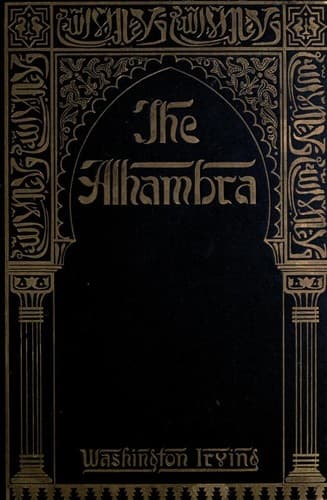
Verhalen over het gebouwencomplex in Granada, dat eigendom was van de laatste islamitische vorsten in Spanje.
Yet here is everything to delight a southern voluptuary: fruits,
flowers, fragrance, green arbors and myrtle hedges, delicate air and
gushing waters. Here I had an opportunity of witnessing those scenes
which painters are fond of depicting about southern palaces and gardens.
It was the saint’s day of the count’s daughter, and she had brought up
several of her youthful companions from Granada, to sport away a long
summer’s day among the breezy halls and bowers of the Moorish palaces. A
visit to the Generalife was the morning’s entertainment. Here some of
the gay company dispersed itself in groups about the green walks, the
bright fountains, the flights of Italian steps, the noble terraces and
marble balustrades. Others, among whom I was one, took their seats in an
open gallery or colonnade commanding a vast prospect; with the Alhambra,
the city, and the Vega, far below, and the distant horizon of
mountains--a dreamy world, all glimmering to the eye in summer sunshine.
While thus seated, the all-pervading tinkling of the guitar and click of
the castanets came stealing up from the valley of the Darro, and
half-way down the mountain we descried a festive party under the trees,
enjoying themselves in true Andalusian style; some lying on the grass,
others dancing to the music.
All these sights and sounds, together with the princely seclusion of the
place, the sweet quiet which prevailed around, and the delicious
serenity of the weather, had a witching effect upon the mind, and drew
from some of the company, versed in local story, several of the popular
fancies and traditions connected with this old Moorish palace; they were
“such stuff as dreams are made of,” but out of them I have shaped the
following legend, which I hope may have the good fortune to prove
acceptable to the reader.
LEGEND OF PRINCE AHMED AL KAMEL
OR, THE PILGRIM OF LOVE
There was once a Moorish king of Granada, who had but one son, whom he
named Ahmed, to which his courtiers added the surname of al Kamel, or
the Perfect, from the indubitable signs of superexcellence which they
perceived in him in his very infancy. The astrologers countenanced them
in their foresight, predicting everything in his favor that could make a
perfect prince and a prosperous sovereign. One cloud only rested upon
his destiny, and even that was of a roseate hue: he would be of an
amorous temperament, and run great perils from the tender passion. If,
however, he could be kept from the allurements of love until of mature
age, these dangers would be averted, and his life thereafter be one
uninterrupted course of felicity.
Public-domain text, read in full here on John Shaqi.
Reviews
Reviews
No reviews yet
Be the first to share your thoughts on this work.
Elsewhere in the archive
Join the Discussion
Join the discussion
Sign in to leave a comment or review.
Sign InorCreate an account