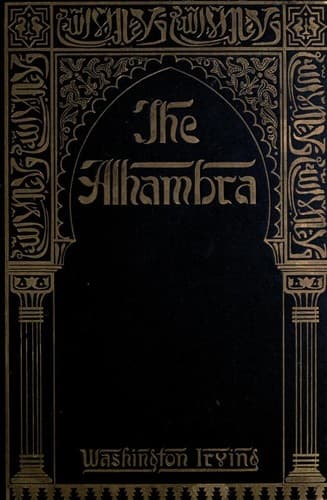
Verhalen over het gebouwencomplex in Granada, dat eigendom was van de laatste islamitische vorsten in Spanje.
The residence provided for the princesses was one of the most dainty
that fancy could devise. It was in a tower somewhat apart from the main
palace of the Alhambra, though connected with it by the wall which
encircled the whole summit of the hill. On one side it looked into the
interior of the fortress, and had, at its foot, a small garden filled
with the rarest flowers. On the other side it overlooked a deep
embowered ravine separating the grounds of the Alhambra from those of
the Generalife. The interior of the tower was divided into small fairy
apartments, beautifully ornamented in the light Arabian style,
surrounding a lofty hall, the vaulted roof of which rose almost to the
summit of the tower. The walls and the ceilings of the hall were adorned
with arabesque and fretwork, sparkling with gold and with brilliant
pencilling. In the centre of the marble pavement was an alabaster
fountain, set round with aromatic shrubs and flowers, and throwing up a
jet of water that cooled the whole edifice and had a lulling sound.
Round the hall were suspended cages of gold and silver wire, containing
singing birds of the finest plumage or sweetest note.
The princesses had been represented as always cheerful when in the
castle of the Salobreña; the king had expected to see them enraptured
with the Alhambra. To his surprise, however, they began to pine, and
grow melancholy, and dissatisfied with everything around them. The
flowers yielded them no fragrance, the song of the nightingale disturbed
their night’s rest, and they were out of all patience with the alabaster
fountain, with its eternal drop-drop and splash-splash, from morning
till night and from night till morning.
The king, who was somewhat of a testy, tyrannical disposition, took this
at first in high dudgeon; but he reflected that his daughters had
arrived at an age when the female mind expands and its desires augment.
“They are no longer children,” said he to himself, “they are women
grown, and require suitable objects to interest them.” He put in
requisition, therefore, all the dressmakers, and the jewellers, and the
artificers in gold and silver throughout the Zacatin of Granada, and the
princesses were overwhelmed with robes of silk, and tissue, and brocade,
and cashmere shawls, and necklaces of pearls and diamonds, and rings,
and bracelets, and anklets, and all manner of precious things.
All, however, was of no avail; the princesses continued pale and languid
in the midst of their finery, and looked like three blighted rose-buds,
drooping from one stalk. The king was at his wits’ end. He had in
general a laudable confidence in his own judgment, and never took
advice. “The whims and caprices of three marriageable damsels, however,
are sufficient,” said he, “to puzzle the shrewdest head.” So for once in
his life he called in the aid of counsel.
The person to whom he applied was the experienced duenna.
Public-domain text, read in full here on John Shaqi.
Reviews
Reviews
No reviews yet
Be the first to share your thoughts on this work.
Elsewhere in the archive
Join the Discussion
Join the discussion
Sign in to leave a comment or review.
Sign InorCreate an account