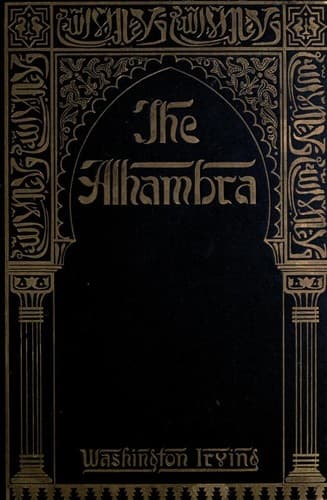
Verhalen over het gebouwencomplex in Granada, dat eigendom was van de laatste islamitische vorsten in Spanje.
The vigilant Fredegonda was one of the most wary of ancient spinsters.
She had a becoming terror and distrust of what she denominated “the
opposite sex,” which had gradually increased through a long life of
celibacy. Not that the good lady had ever suffered from their wiles,
nature having set up a safeguard in her face that forbade all trespass
upon her premises; but ladies who have least cause to fear for
themselves are most ready to keep a watch over their more tempting
neighbors.
The niece was an orphan of an officer who had fallen in the wars. She
had been educated in a convent, and had recently been transferred from
her sacred asylum to the immediate guardianship of her aunt, under whose
overshadowing care she vegetated in obscurity, like an opening rose
blooming beneath a brier. Nor indeed is this comparison entirely
accidental; for, to tell the truth, her fresh and dawning beauty had
caught the public eye, even in her seclusion, and, with that poetical
turn common to the people of Andalusia, the peasantry of the
neighborhood had given her the appellation of “the Rose of the
Alhambra.”
The wary aunt continued to keep a faithful watch over her tempting
little niece as long as the court continued at Granada, and flattered
herself that her vigilance had been successful. It is true the good lady
was now and then discomposed by the tinkling of guitars and chanting of
love-ditties from the moonlit groves beneath the tower; but she would
exhort her niece to shut her ears against such idle minstrelsy, assuring
her that it was one of the arts of the opposite sex, by which simple
maids were often lured to their undoing. Alas! what chance with a simple
maid has a dry lecture against a moonlight serenade?
At length King Philip cut short his sojourn at Granada, and suddenly
departed with all his train. The vigilant Fredegonda watched the royal
pageant as it issued forth from the Gate of Justice, and descended the
great avenue leading to the city. When the last banner disappeared from
her sight, she returned exulting to her tower, for all her cares were
over. To her surprise, a light Arabian steed pawed the ground at the
wicket-gate of the garden;--to her horror, she saw through the thickets
of roses a youth in gayly embroidered dress, at the feet of her niece.
At the sound of her footsteps he gave a tender adieu, bounded lightly
over the barrier of reeds and myrtles, sprang upon his horse, and was
out of sight in an instant.
The tender Jacinta, in the agony of her grief, lost all thought of her
aunt’s displeasure. Throwing herself into her arms, she broke forth into
sobs and tears.
“Ay de mi!” cried she; “he’s gone!--he’s gone!--he’s gone! and I shall
never see him more!”
“Gone!--who is gone?--what youth is that I saw at your feet?”
“A queen’s page, aunt, who came to bid me farewell.”
“A queen’s page, child!” echoed the vigilant Fredegonda, faintly, “and
when did you become acquainted with the queen’s page?”
Public-domain text, read in full here on John Shaqi.
Reviews
Reviews
No reviews yet
Be the first to share your thoughts on this work.
Elsewhere in the archive
Join the Discussion
Join the discussion
Sign in to leave a comment or review.
Sign InorCreate an account