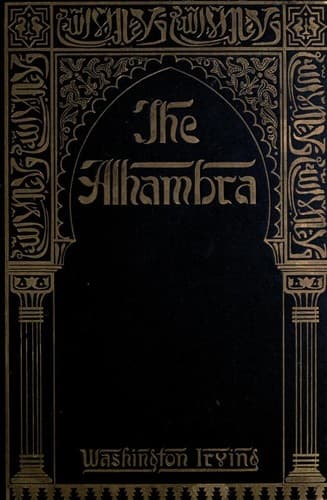
Verhalen over het gebouwencomplex in Granada, dat eigendom was van de laatste islamitische vorsten in Spanje.
The words of the immaculate Fredegonda only served to increase the
melancholy of her niece, but she sought to indulge it in private. At a
late hour one midsummer night, after her aunt had retired to rest, she
remained alone in the hall of the tower, seated beside the alabaster
fountain. It was here that the faithless page had first knelt and kissed
her hand; it was here that he had often vowed eternal fidelity. The poor
little damsel’s heart was overladen with sad and tender recollections,
her tears began to flow, and slowly fell drop by drop into the
fountain. By degrees the crystal water became agitated,
and--bubble--bubble--bubble--boiled up and was tossed about, until a
female figure, richly clad in Moorish robes, slowly rose to view.
Jacinta was so frightened that she fled from the hall, and did not
venture to return. The next morning she related what she had seen to her
aunt, but the good lady treated it as a fantasy of her troubled mind, or
supposed she had fallen asleep and dreamt beside the fountain. “Thou
hast been thinking of the story of the three Moorish princesses that
once inhabited this tower,” continued she, “and it has entered into thy
dreams.”
“What story, aunt? I know nothing of it.”
“Thou hast certainly heard of the three princesses, Zayda, Zorayda, and
Zorahayda, who were confined in this tower by the king their father, and
agreed to fly with three Christian cavaliers. The two first accomplished
their escape, but the third failed in her resolution, and, it is said,
died in this tower.”
“I now recollect to have heard of it,” said Jacinta, “and to have wept
over the fate of the gentle Zorahayda.”
“Thou mayest well weep over her fate,” continued the aunt, “for the
lover of Zorahayda was thy ancestor. He long bemoaned his Moorish love;
but time cured him of his grief, and he married a Spanish lady, from
whom thou art descended.”
Jacinta ruminated upon these words. “That what I have seen is no fantasy
of the brain,” said she to herself, “I am confident. If indeed it be the
spirit of the gentle Zorahayda, which I have heard lingers about this
tower, of what should I be afraid? I’ll watch by the fountain
to-night--perhaps the visit will be repeated.”
Towards midnight, when everything was quiet, she again took her seat in
the hall. As the bell in the distant watch-tower of the Alhambra struck
the midnight hour, the fountain was again agitated; and
bubble--bubble--bubble--it tossed about the waters until the Moorish
female again rose to view. She was young and beautiful; her dress was
rich with jewels, and in her hand she held a silver lute. Jacinta
trembled and was faint, but was reassured by the soft and plaintive
voice of the apparition, and the sweet expression of her pale,
melancholy countenance.
“Daughter of mortality,” said she, “what aileth thee? Why do thy tears
trouble my fountain, and thy sighs and plaints disturb the quiet watches
of the night?”
Public-domain text, read in full here on John Shaqi.
Reviews
Reviews
No reviews yet
Be the first to share your thoughts on this work.
Elsewhere in the archive
Join the Discussion
Join the discussion
Sign in to leave a comment or review.
Sign InorCreate an account