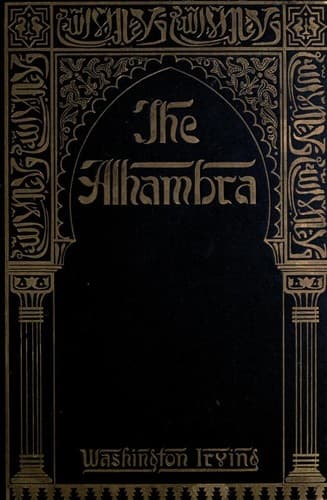
Verhalen over het gebouwencomplex in Granada, dat eigendom was van de laatste islamitische vorsten in Spanje.
In the year of redemption, 1394, there was a valiant and devout grand
master of Alcántara, named Martin Yañez de Barbudo, who was inflamed
with a vehement desire to serve God and fight the Moors. Unfortunately
for this brave and pious cavalier, a profound peace existed between the
Christian and Moslem powers. Henry III had just ascended the throne of
Castile, and Yusef ben Mohammed had succeeded to the throne of Granada,
and both were disposed to continue the peace which had prevailed between
their fathers. The grand master looked with repining at Moorish banners
and weapons, which decorated his castle-hall, trophies of the exploits
of his predecessors; and repined at his fate to exist in a period of
such inglorious tranquillity.
At length his impatience broke through all bounds, and seeing that he
could find no public war in which to engage, he resolved to carve out a
little war for himself. Such at least is the account given by some
ancient chronicles, though others give the following as the motive for
this sudden resolution to go campaigning.
As the grand master was one day seated at table with several of his
cavaliers, a man suddenly entered the hall,--tall, meagre, and bony,
with haggard countenance and fiery eye. All recognized him for a hermit,
who had been a soldier in his youth, but now led a life of penitence in
a cave. He advanced to the table and struck upon it with a fist that
seemed of iron. “Cavaliers,” said he, “why sit ye here idly, with your
weapons resting against the wall, while the enemies of the faith lord it
over the fairest portion of the land?”
“Holy father, what wouldst thou have us do,” asked the grand master,
“seeing the wars are over and our swords bound up by treaties of peace?”
“Listen to my words,” replied the hermit. “As I was seated late at night
at the entrance of my cave, contemplating the heavens, I fell into a
reverie, and a wonderful vision was presented to me. I beheld the moon,
a mere crescent, yet luminous as the brightest silver, and it hung in
the heavens over the kingdom of Granada. While I was looking at it,
behold there shot forth from the firmament a blazing star, which, as it
went, drew after it all the stars of heaven; and they assailed the moon
and drove it from the skies; and the whole firmament was filled with the
glory of that blazing star. While mine eyes were yet dazzled by this
wondrous sight, some one stood by me with snowy wings and a shining
countenance. ‘Oh man of prayer,’ said he, ‘get thee to the grand master
of Alcántara and tell him of the vision thou hast beheld. He is the
blazing star, destined to drive the crescent, the Moslem emblem, from
the land. Let him boldly draw the sword and continue the good work begun
by Pelazo of old, and victory will assuredly attend his banner.’”
Public-domain text, read in full here on John Shaqi.
Reviews
Reviews
No reviews yet
Be the first to share your thoughts on this work.
Elsewhere in the archive
Join the Discussion
Join the discussion
Sign in to leave a comment or review.
Sign InorCreate an account