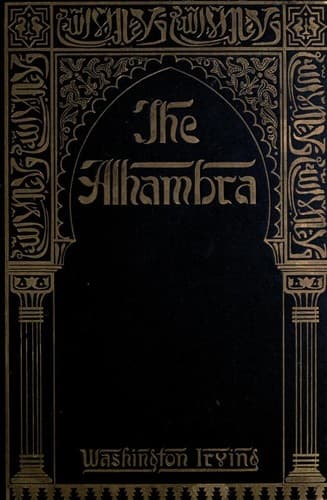
Verhalen over het gebouwencomplex in Granada, dat eigendom was van de laatste islamitische vorsten in Spanje.
In this way, then, did our ragged and musical son of learning make his
way over half the kingdom; with the fixed determination to visit the
famous city of Granada before his return. Sometimes he was gathered for
the night into the fold of some village pastor; sometimes he was
sheltered under the humble but hospitable roof of the peasant. Seated at
the cottage-door with his guitar, he delighted the simple folk with his
ditties; or striking up a fandango or bolero, set the brown country lads
and lasses dancing in the mellow twilight. In the morning he departed
with kind words from host and hostess, and kind looks and, peradventure,
a squeeze of the hand from the daughter.
At length he arrived at the great object of his musical vagabondizing,
the far-famed city of Granada, and hailed with wonder and delight its
Moorish towers, its lovely Vega, and its snowy mountains glistening
through a summer atmosphere. It is needless to say with what eager
curiosity he entered its gates and wandered through its streets, and
gazed upon its Oriental monuments. Every female face peering through a
window or beaming from a balcony was to him a Zorayda or a Zelinda, nor
could he meet a stately dame on the Alameda but he was ready to fancy
her a Moorish princess, and to spread his student’s robe beneath her
feet.
His musical talent, his happy humor, his youth and his good looks, won
him a universal welcome in spite of his ragged robes, and for several
days he led a gay life in the old Moorish capital and its environs. One
of his occasional haunts was the fountain of Avellanos, in the valley of
Darro. It is one of the popular resorts of Granada, and has been so
since the days of the Moors; and here the student had an opportunity of
pursuing his studies of female beauty; a branch of study to which he was
a little prone.
Here he would take his seat with his guitar, improvise love-ditties to
admiring groups of majos and majas, or prompt with his music the
ever-ready dance. He was thus engaged one evening when he beheld a padre
of the church advancing, at whose approach every one touched the hat. He
was evidently a man of consequence; he certainly was a mirror of good if
not of holy living; robust and rosy-faced, and breathing at every pore
with the warmth of the weather and the exercise of the walk. As he
passed along he would every now and then draw a maravedi out of his
pocket and bestow it on a beggar, with an air of signal beneficence.
“Ah, the blessed father!” would be the cry; “long life to him, and may
he soon be a bishop!”
Public-domain text, read in full here on John Shaqi.
Reviews
Reviews
No reviews yet
Be the first to share your thoughts on this work.
Elsewhere in the archive
Join the Discussion
Join the discussion
Sign in to leave a comment or review.
Sign InorCreate an account