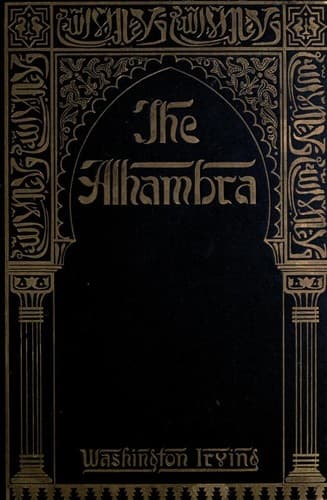
Verhalen over het gebouwencomplex in Granada, dat eigendom was van de laatste islamitische vorsten in Spanje.
Among the ancient superstitions of Spain, were those of the
existence of profound caverns in which the magic arts were taught,
either by the devil in person, or some sage devoted to his service.
One of the most famous of these caves was at Salamanca. Don
Francisco de Torreblanca makes mention of it in the first book of
his work on magic, C. 2, No. 4. The devil was said to play the part
of Oracle there; giving replies to those who repaired thither to
propound fateful questions, as in the celebrated cave of
Trophonius. Don Francisco, though he records this story, does not
put faith in it: he gives it however as certain, that a Sacristan,
named Clement Potosi, taught secretly the magic arts in that cave.
Padre Feyjoo, who inquired into the matter, reports it as a vulgar
belief, that the devil himself taught those arts there; admitting
only seven disciples at a time, one of whom, to be determined by
lot, was to be devoted to him body and soul forever. Among one of
these sets of students was a young man, son of the Marquis de
Villena, on whom, after having accomplished his studies, the lot
fell. He succeeded, however, in cheating the devil, leaving him his
shadow instead of his body.
Don Juan de Dios, Professor of Humanities in the University, in the
early part of the last century, gives the following version of the
story, extracted, as he says, from an ancient manuscript. It will
be perceived he has marred the supernatural part of the tale, and
ejected the devil from it altogether.
As to the fable of the Cave of San Cyprian, says he, all that we
have been able to verify is, that where the stone cross stands, in
the small square or place called by the name of the Seminary of
Carvajal, there was the parochial church of San Cyprian. A descent
of twenty steps led down to a subterranean Sacristy, spacious and
vaulted like a cave. Here a Sacristan once taught magic, judicial
astrology, geomancy, hydromancy, pyromancy, acromancy, chiromancy,
necromancy, &c.
The extract goes on to state that seven students engaged at a time
with the Sacristan, at a fixed stipend. Lots were cast among them
which one of their number should pay for the whole, with the
understanding that he on whom the lot fell, if he did not pay
promptly, should be detained in a chamber of the Sacristy until the
funds were forthcoming. This became thenceforth the usual practice.
Public-domain text, read in full here on John Shaqi.
Reviews
Reviews
No reviews yet
Be the first to share your thoughts on this work.
Elsewhere in the archive
Join the Discussion
Join the discussion
Sign in to leave a comment or review.
Sign InorCreate an account