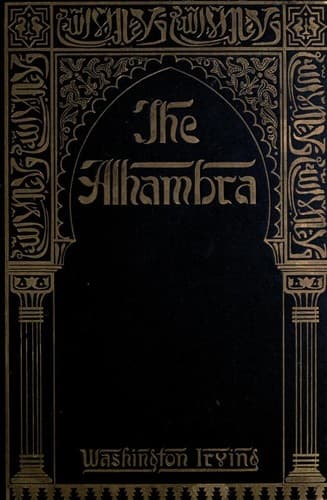
Verhalen over het gebouwencomplex in Granada, dat eigendom was van de laatste islamitische vorsten in Spanje.
[7] Una de las cosas en que tienen precisa intervencion los Reyes
Moros as en el matrimonio de sus grandes: de aqui nace que todos los
señores llegadas à la persona real si casan en palacio, y siempre huvo
su quarto destinado para esta ceremonia.
One of the things in which the Moorish kings interfered was in the
marriage of their nobles: hence it came that all the señors attached
to the royal person were married in the palace; and there was always a
chamber destined for the ceremony.--_Paseos por Granada_, Paseo XXI.
[8] Alcántara, _Hist. Granad._, O. 3, p. 226, note.
[9] Salazar y Castro, _Hist. Genealog. de la Casa de Lara_, lib. v. c.
12, cited by Alcántara in his _Hist. Granad._
[10] Al Makkari, B. VIII. c. 7.
[11] Alcántara, _Hist. Granad._, c. 17. See also Al Makkari, _Hist.
Mohama. Dynasties_, B. VIII. c. 7, with the Commentaries of Don
Pascual de Guyangos.
[12] For authorities for these latter facts, see the Appendix to the
author’s revised edition of the _Conquest of Granada_.
[13] Ay una puerta en la Alhambra por la qual salio Chico Rey de los
Moros, quando si rindio prisionero al Rey de España D. Fernando, y
le entregó la ciudad con el castillo. Pidio esta principe como por
merced, y en memoria de tan importante conquista, al que quedasse
siempre cerrada esta puerta. Consintio en allo el Rey Fernando, y des
de aquel tiempo no solamente no se abrio la puerta sino tambien se
construyo junto à ella fuerte bastion.--MORERI’S _Historical
Dictionary_, Spanish Edition, Vol. I. p. 372.
[14] The minor details of the surrender of Granada have been stated
in different ways even by eye-witnesses. The author, in his revised
edition of the _Conquest_, has endeavored to adjust them according to
the latest and apparently best authorities.
[15] See a more detailed account of the exploit in the chronicle of
the _Conquest of Granada_.
[16] Marmol, _Hist. Rebellion of the Moors._
[17] Lest this should be deemed a mere stretch of fancy, the reader
is referred to the following genealogy, derived by the historian
Alcántara, from an Arabian manuscript, on parchment, in the
archives of the Marquis of Corvera. It is a specimen of the curious
affinities between Christians and Moslems, produced by capture and
intermarriages, during the Moorish wars. From Aben Hud, the Moorish
king, the conqueror of the Almohades, was descended in right line Cid
Yahia Abraham Alnagar, prince of Almeria, who married a daughter of
King Bermejo. They had three children, commonly called the Cetimerian
Princes. 1st. _Jusef ben Alhamar_, who for a time usurped the throne
of Granada. 2d. The Prince _Nasar_, who married the celebrated
Lindaraxa. 3d. The _Princess Cetimerien_, who married Don Pedro
Venegas captured by the Moors in his boyhood, a younger son of the
_House of Luque_, of which house the old court was the present head.
Public-domain text, read in full here on John Shaqi.
Reviews
Reviews
No reviews yet
Be the first to share your thoughts on this work.
Elsewhere in the archive
Join the Discussion
Join the discussion
Sign in to leave a comment or review.
Sign InorCreate an account