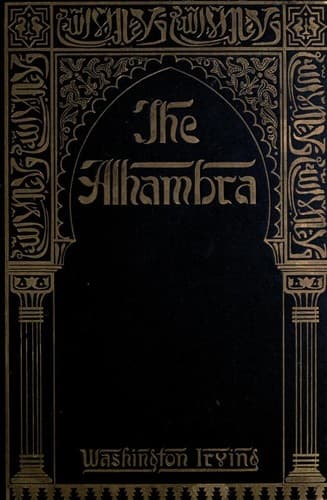
Verhalen over het gebouwencomplex in Granada, dat eigendom was van de laatste islamitische vorsten in Spanje.
The genius of a sovereign stamps a character upon his time. The nobles
of Granada, imitating the elegant and graceful taste of Yusef, soon
filled the city of Granada with magnificent palaces; the halls of which
were paved with mosaic, the walls and ceilings wrought in fretwork, and
delicately gilded and painted with azure, vermilion, and other brilliant
colors, or minutely inlaid with cedar and other precious woods;
specimens of which have survived, in all their lustre, the lapse of
several centuries. Many of the houses had fountains, which threw up jets
of water to refresh and cool the air. They had lofty towers also, of
wood or stone, curiously carved and ornamented, and covered with plates
of metal that glittered in the sun. Such was the refined and delicate
taste in architecture that prevailed among this elegant people; insomuch
that, to use the beautiful simile of an Arabian writer, “Granada, in the
days of Yusef, was as a silver vase filled with emeralds and jacinths.”
One anecdote will be sufficient to show the magnanimity of this generous
prince. The long truce which had succeeded the battle of Salado was at
an end, and every effort of Yusef to renew it was in vain. His deadly
foe, Alfonso XI. of Castile, took the field with great force, and laid
siege to Gibraltar. Yusef reluctantly took up arms, and sent troops to
the relief of the place. In the midst of his anxiety, he received
tidings that his dreaded foe had suddenly fallen a victim to the plague.
Instead of manifesting exultation on the occasion, Yusef called to mind
the great qualities of the deceased, and was touched with a noble
sorrow. “Alas!” cried he, “the world has lost one of its most excellent
princes; a sovereign who knew how to honor merit, whether in friend or
foe!”
The Spanish chroniclers themselves bear witness to this magnanimity.
According to their accounts, the Moorish cavaliers partook of the
sentiment of their king, and put on mourning for the death of Alfonzo.
Even those of Gibraltar, who had been so closely invested, when they
knew that the hostile monarch lay dead in his camp, determined among
themselves that no hostile movement should be made against the
Christians. The day on which the camp was broken up, and the army
departed, bearing the corpse of Alfonzo, the Moors issued in multitudes
from Gibraltar, and stood mute and melancholy, watching the mournful
pageant. The same reverence for the deceased was observed by all the
Moorish commanders on the frontiers, who suffered the funeral train to
pass in safety, bearing the corpse of the Christian sovereign from
Gibraltar to Seville.[6]
Public-domain text, read in full here on John Shaqi.
Reviews
Reviews
No reviews yet
Be the first to share your thoughts on this work.
Join the Discussion
Join the discussion
Sign in to leave a comment or review.
Sign InorCreate an account