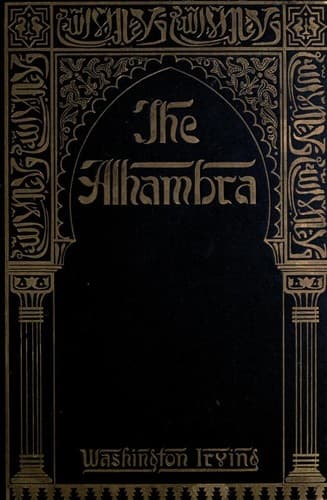
Verhalen over het gebouwencomplex in Granada, dat eigendom was van de laatste islamitische vorsten in Spanje.
To the foregoing particulars, concerning the Moslem princes who once
reigned in these halls, I shall add a brief notice of the monarch who
completed and embellished the Alhambra. Yusef Abul Hagig (or, as it is
sometimes written, Haxis) was another prince of the noble line of Nasar.
He ascended the throne of Granada in the year of grace 1333, and is
described by Moslem writers as having a noble presence, great bodily
strength, and a fair complexion; and the majesty of his countenance
increased, say they, by suffering his beard to grow to a dignified
length and dyeing it black. His manners were gentle, affable, and
urbane; he carried the benignity of his nature into warfare, prohibiting
all wanton cruelty, and enjoining mercy and protection towards women and
children, the aged and infirm, and all friars and other persons of holy
and recluse life. But though he possessed the courage common to generous
spirits, the bent of his genius was more for peace than war, and though
repeatedly obliged by circumstances to take up arms, he was generally
unfortunate.
Among other ill-starred enterprises, he undertook a great campaign, in
conjunction with the king of Morocco, against the kings of Castile and
Portugal, but was defeated in the memorable battle of Salado, which had
nearly proved a death-blow to the Moslem power in Spain.
Yusef obtained a long truce after this defeat, and now his character
shone forth in its true lustre. He had an excellent memory, and had
stored his mind with science and erudition; his taste was altogether
elegant and refined, and he was accounted the best poet of his time.
Devoting himself to the instruction of his people and the improvement of
their morals and manners, he established schools in all the villages,
with simple and uniform systems of education; he obliged every hamlet of
more than twelve houses to have a mosque, and purified the ceremonies of
religion, and the festivals and popular amusements, from various abuses
and indecorums which had crept into them. He attended vigilantly to the
police of the city, establishing nocturnal guards and patrols, and
superintending all municipal concerns. His attention was also directed
towards finishing the great architectural works commenced by his
predecessors, and erecting others on his own plans. The Alhambra, which
had been founded by the good Alhamar, was now completed. Yusef
constructed the beautiful Gate of Justice, forming the grand entrance to
the fortress, which he finished in 1348. He likewise adorned many of the
courts and halls of the palace, as may be seen by the inscriptions on
the walls, in which his name repeatedly occurs. He built also the noble
Alcazar or citadel of Malaga, now unfortunately a mere mass of crumbling
ruins, but which most probably exhibited in its interior similar
elegance and magnificence with the Alhambra.
Public-domain text, read in full here on John Shaqi.
Reviews
Reviews
No reviews yet
Be the first to share your thoughts on this work.
Join the Discussion
Join the discussion
Sign in to leave a comment or review.
Sign InorCreate an account